Last updated: November 2026
Munich is one of the best bases in Europe for day trips, because the Alps, the lakes and several of Germany’s most historic cities sit within a few hours by train. The best day trips from Munich are Neuschwanstein Castle, Salzburg, Nuremberg, Regensburg and the Zugspitze, with lakes, palaces and a memorial site for quieter options. Most of them are simple rail journeys from Munich Hauptbahnhof, and you can be back in the city for dinner. If you want to round off a day out with a local meal, read our guide to the best beer halls and beer gardens in Munich before you go.
This guide covers ten day trips, each with a practical box for getting there and how long to allow. Further down you will find advice on choosing between them, a free printable 3-day Munich day trip itinerary, getting around, where to stay and what it all costs. For regional train deals, the Deutsche Bahn Bavaria regional travel page explains the Bayern-Ticket, a day pass for regional trains that can save money when you plan several trips.
Timetables, ticket rules and opening days change, and sources often disagree on exact journey times. We give safe bands rather than exact times or prices, and we say “check before you go” wherever we could not confirm something.
Quick answer: What are the best day trips from Munich? For fairy-tale scenery, go to Neuschwanstein Castle. For a big-name city, take the train to Salzburg or Nuremberg. For mountains, choose Garmisch-Partenkirchen and the Zugspitze. For something quieter, try Regensburg, Lake Starnberg or Herrenchiemsee, and keep Dachau, Augsburg and Königssee for a more focused history or lake day.
Free printable itinerary
Planning a trip? Download our 3-Day Munich Day Trips Itinerary as a PDF: the day-by-day plan plus all 10 places with directions and map links. Print it or keep it on your phone.
Quick comparison: the best day trips from Munich
| Day trip | Best for | Getting there | Time each way |
|---|---|---|---|
| Neuschwanstein Castle | A fairy-tale castle | Train to Füssen, then bus | About 2 to 2.5 hours |
| Salzburg | Mozart, music and old town streets | Direct regional train | About 1.5 to 2 hours |
| Nuremberg | Medieval walls and 20th-century history | Fast train | About 1 to 1.5 hours |
| Regensburg | A UNESCO old town on the Danube | Regional train | About 1.5 to 2 hours |
| Garmisch-Partenkirchen and the Zugspitze | Germany’s highest mountain | Train, cog railway and cable car | About 1.5 hours to Garmisch |
| Dachau Memorial Site | History and reflection | S-Bahn and bus | About 40 minutes |
| Lake Starnberg | Lake views and royal history | S-Bahn | About 30 to 45 minutes |
| Herrenchiemsee | A palace on an island | Train, then ferry | About 1 to 1.5 hours to Prien |
| Augsburg | Roman roots and the Fuggerei | Regional train | About 30 to 50 minutes |
| Königssee | An Alpine fjord-like lake | Train, bus and boat | About 3 hours |
1. Neuschwanstein Castle
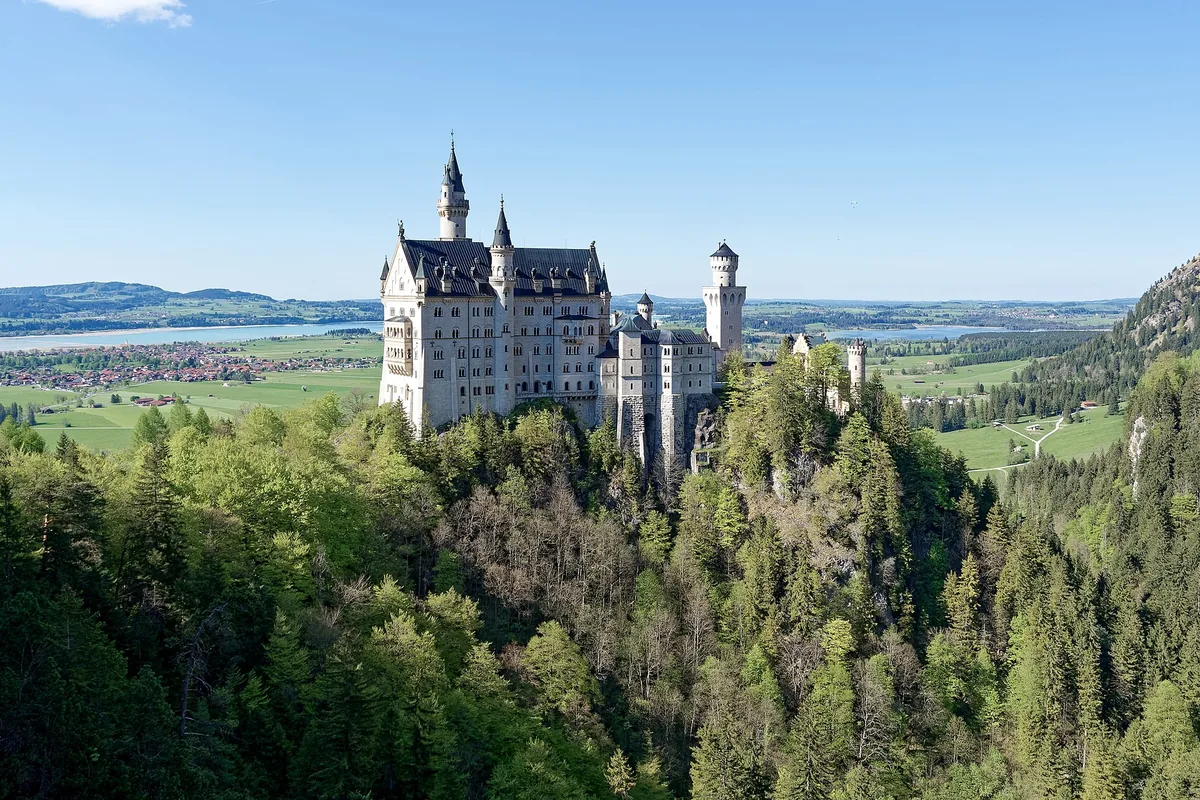
Neuschwanstein is the most famous castle in Germany and the most popular day trip from Munich. King Ludwig II began building it in the nineteenth century as a romantic hilltop palace, and it stands above the village of Hohenschwangau near Füssen, with the Alps behind and a gorge and lake below. The look of the place has inspired storybook castles ever since. If castles are your main reason for visiting, our guide to the most magical castles in Germany shows where else to find them.
The practical side matters more than for any other trip here. The official ticket centre states that Neuschwanstein and nearby Hohenschwangau Castle can only be visited as part of a guided tour at a fixed entry time, and advance tickets are sold through the official online shop. A limited number of same-day tickets are sold at the ticket centre, but they can sell out by late morning, so booking ahead is the safe choice. Check the official Hohenschwangau ticket information for the current rules.
From Füssen station, local buses take roughly ten minutes to Hohenschwangau. From there it is an uphill walk to the castle, so allow time before your tour. Many visitors also walk to the Marienbrücke bridge for the classic view of the castle, though access and conditions can vary, so check locally.
Hohenschwangau Castle, Ludwig’s childhood home, is also open on tour, and combination tickets exist if you want both. The village has cafes and restaurants, but they get busy at midday.
- How to get there: Train from Munich Hauptbahnhof to Füssen, often with one change, then a local bus to Hohenschwangau.
- How long to spend: A full day, with the tour itself fairly short but the walk up and the queue adding time.
- Best time to go: Spring and autumn, or weekday mornings in summer. Winter can be atmospheric but check conditions on the paths.
- Tip: Book your timed tour first, then build the rest of the day around it.
2. Salzburg
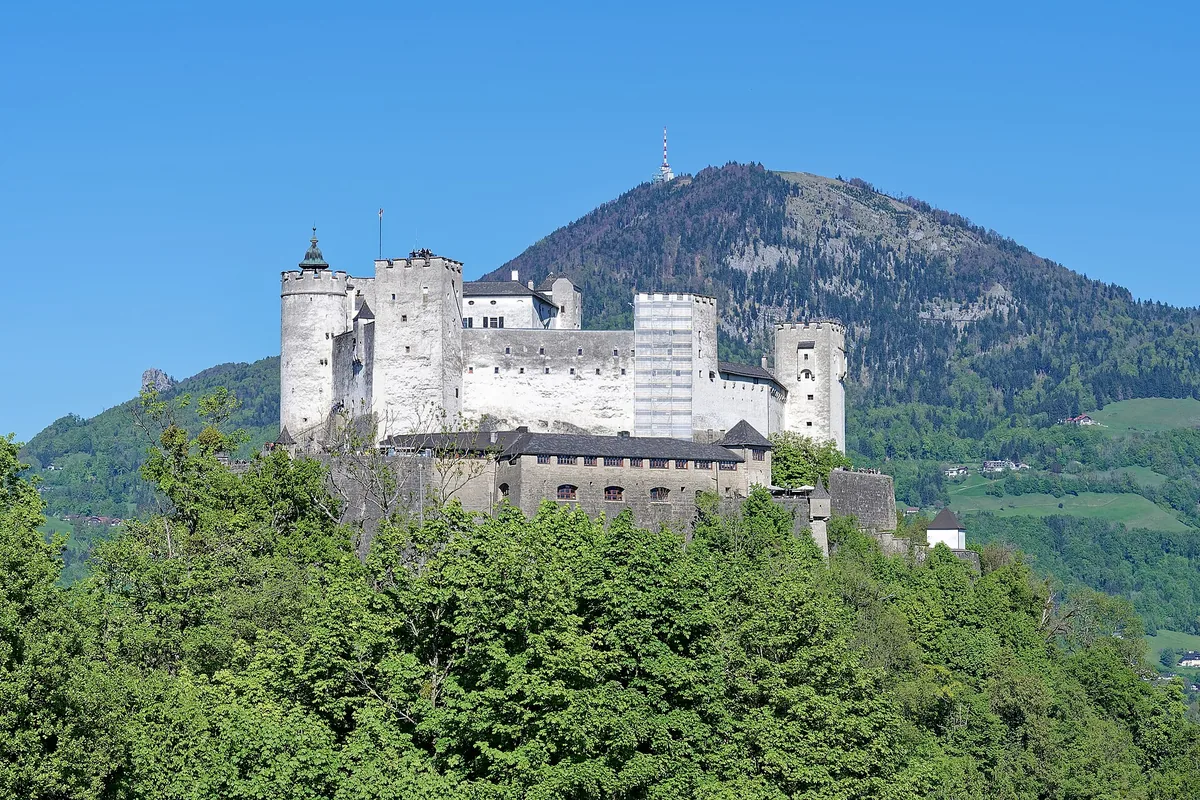
Salzburg is the easiest international day trip from Munich, and one of the most beautiful small cities in Europe. Regional trains run roughly hourly across the border to Salzburg Hauptbahnhof, and the journey is usually under two hours. Some regional services accept the Bayern-Ticket, but check the route before you buy.
The old town is compact and sits between the Salzach river and the cliff of the Mönchsberg. Start in the area around Getreidegasse, the busy shopping street known for its wrought-iron guild signs and as the address of Mozart’s birthplace. Salzburg’s music heritage runs through the whole city, from the cathedral to the concert halls.
Above the old town, Hohensalzburg Fortress is one of the biggest medieval castles in Europe and gives the best view over the rooftops. You can walk up or use the funicular. Back in the valley, the Mirabell Gardens, with their formal flowerbeds and views up to the fortress, are free to enter and an easy place to rest between sights.
If you have time, cross the river to the Mozart residence or wander the quieter streets around the university. Salzburg is also famous for its Christmas markets in winter, when the day trip becomes very popular, so book trains early. To compare it with other festive towns, see our round-up of the best Christmas markets in Europe.
- How to get there: Regional or direct train from Munich Hauptbahnhof to Salzburg Hauptbahnhof, about an hour and a half to two hours.
- How long to spend: A full day. An early train gives you time for the fortress, old town and gardens.
- Best time to go: Late spring to autumn for the gardens, or December for the Christmas markets.
- Tip: Bring your passport or ID in case of border checks, and check whether your ticket is valid on the exact train.
3. Nuremberg
Nuremberg is the best city day trip if you like medieval streets and serious twentieth-century history in the same visit. Fast trains cover the distance from Munich in a little over an hour, and trains are frequent. Note that the Bayern-Ticket does not cover long-distance trains, so you would need a regional service if you use it.
The old town sits inside a long ring of medieval walls, with half-timbered houses, churches and squares. The Imperial Castle (Kaiserburg) rises above it on a sandstone ridge and gives views over the red rooftops. Down in the old town, the main market square hosts a famous Christmas market in winter, and in other seasons it is a good place to try Nuremberg’s small grilled sausages and gingerbread, a local speciality.
The city also has a heavy twentieth-century past. The Documentation Centre at the former Nazi Party Rally Grounds explains how the regime used the site, and the Nuremberg trials took place in the city’s Palace of Justice, where there is a memorial museum. Plan these as a separate half day if you want to see them properly, and check opening days before you go.
Because there is so much, decide before you leave whether you want the old town, the history sites or a mix. The city is walkable, and local trams and the U-Bahn connect the outer sites.
- How to get there: Fast train from Munich Hauptbahnhof to Nuremberg Hauptbahnhof, about an hour to an hour and a half.
- How long to spend: A full day.
- Best time to go: Spring to autumn, or late November and December for the Christmas market.
- Tip: Walk the old town and castle in the morning, and leave the Rally Grounds for the afternoon or a later visit.
4. Regensburg
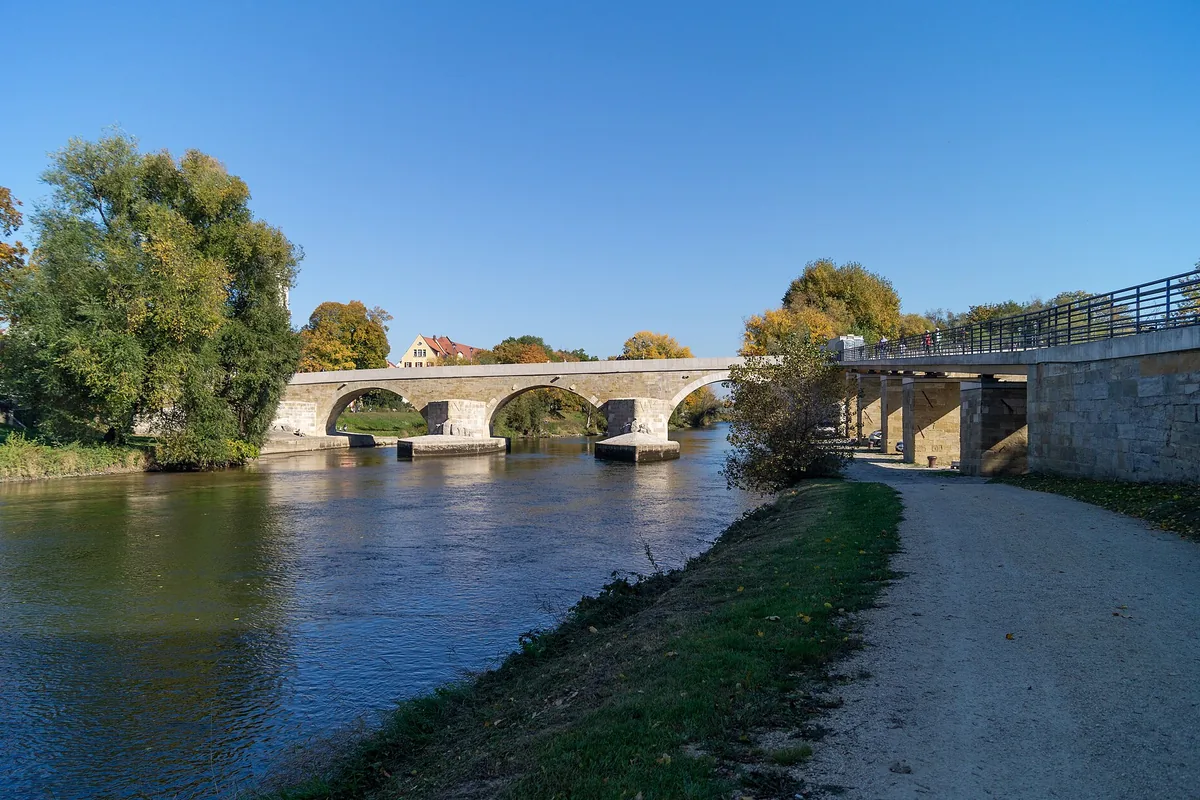
Regensburg is a hidden favourite: a medieval old town on the Danube with far fewer crowds than Munich or Nuremberg. It was added to the UNESCO World Heritage list in 2006 and is often described as one of the best preserved medieval city centres in Germany. Trains from Munich usually take about an hour and a half to two hours, depending on the service. The Munich tourist board has a short overview of the city.
The best-known sight is the twelfth-century Stone Bridge, which has sixteen arches and has carried only pedestrians and cyclists since 2008. Walk across for the view back to the old town, then explore the lanes, towers and courtyards. The Gothic Regensburg Cathedral (Dom St. Peter) dominates the skyline, and the Alte Kapelle, a small Romanesque church with a richly decorated eighteenth-century interior, is worth a look if it is open.
The riverside is a pleasant place to eat. Regensburg is known for traditional Bavarian sausages by the river, so lunch can be part of the sightseeing, though check which places are open before you go. The city is also a student town, so cafes and beer gardens fill up on warm evenings.
The old town is small enough to see in a few hours, so it combines well with a relaxed lunch and a stroll along the Danube. If you want a longer day, add a short walk to the Stadtamhof side of the river for views back at the skyline.
- How to get there: Regional train from Munich Hauptbahnhof to Regensburg Hauptbahnhof, usually about an hour and a half to two hours.
- How long to spend: Four to six hours.
- Best time to go: Spring to autumn, when beer gardens and riverside terraces are open.
- Tip: The old town is a short walk from the station, so you can see the main sights without any local transport.
5. Garmisch-Partenkirchen and the Zugspitze
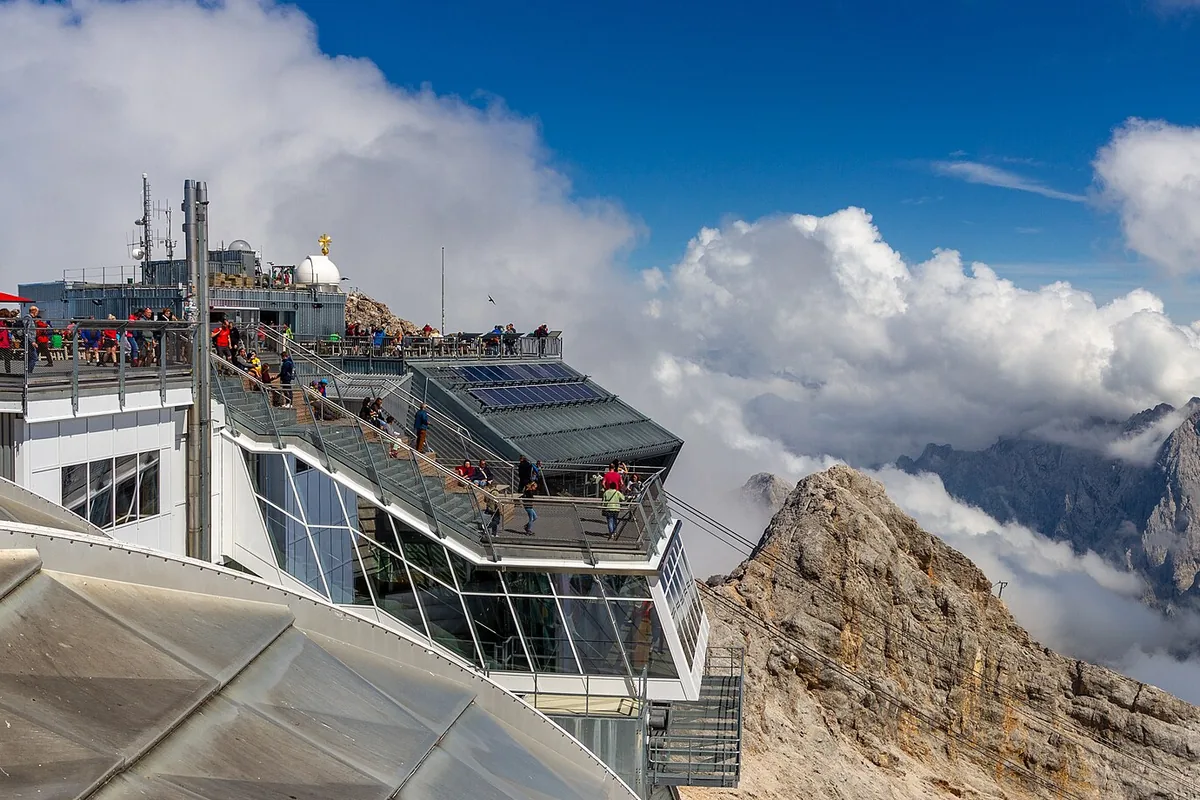
Garmisch-Partenkirchen is the gateway to the Zugspitze, Germany’s highest mountain, and the best Alpine day trip from Munich. Regional trains run from Munich to Garmisch in roughly an hour and a half, and the town sits in a wide valley surrounded by peaks.
The Zugspitze has a few ways up. The Bavarian Zugspitzbahn cog railway leaves from beside the Garmisch railway station and runs to Eibsee in around half an hour, where the cable car climbs to the summit in about ten minutes. The Deutschland-Ticket only covers the cog railway between Garmisch-Partenkirchen and Grainau, so a separate ticket is needed for the rest. Read the operator’s directions and public transport page before you go.
At the top, a viewing terrace looks across the Alps on a clear day. Weather decides everything: check the forecast and webcams on the morning you travel, and have a plan B in the valley if cloud sits on the summit. Eibsee itself, a lake below the cable car, has a walking path around it and is lovely even when the peak is hidden.
If the summit is not for you, Garmisch has a pleasant pedestrian centre, and the Partnach Gorge nearby is a popular short walk, although you should check current access before you set out.
- How to get there: Regional train from Munich Hauptbahnhof to Garmisch-Partenkirchen, then the cog railway to Eibsee and the cable car to the summit.
- How long to spend: A full day, with extra time if you walk around Eibsee.
- Best time to go: Clear summer and early autumn days. Check conditions before you leave.
- Tip: Buses and the cable car get crowded around midday, so aim to start early and to be back down before the late afternoon rush.
6. Dachau Memorial Site
The Dachau Concentration Camp Memorial Site is a serious but important day trip from Munich, and it is easy to reach by public transport. It was the first Nazi concentration camp, and today it is a memorial and museum. It is not a typical sightseeing stop, and visitors are asked to behave with respect.
Entry is free according to the official city information, and you do not need to book ahead. The usual route is the S2 S-Bahn from Munich to Dachau station, then bus 726 to the memorial stop. The trip takes around 40 minutes each way. The Munich city guide to the memorial site gives the latest practical information.
Audio guides and guided tours are available for a fee, and prices differ between sources, so check the memorial’s website for current details and tour booking rules. A visit with an audio guide is a good way to follow the exhibition at your own pace, and a guided tour gives more context for first-time visitors. Allow several hours, because the grounds and the museum are large and emotionally demanding.
Because of the subject, many visitors prefer to plan the rest of the day gently, perhaps with a walk through the nearby old town of Dachau, which has a castle and a pleasant garden.
- How to get there: S2 from Munich Hauptbahnhof to Dachau, then bus 726 to KZ-Gedenkstätte.
- How long to spend: Half a day.
- Best time to go: Weekday mornings are usually quieter. Check opening days before you go.
- Tip: A Munich public transport day ticket can cover the train and bus, so check the zone before you buy.
7. Lake Starnberg
Lake Starnberg is the easiest escape from Munich, reached by S-Bahn in about half an hour. The S6 runs from the city towards Tutzing and stops at Starnberg, where the lake pier is right beside the station. It is a favourite for locals on sunny weekends.
The lake is long, and the best way to see it is by boat. Bayerische Seenschifffahrt runs boats in the warmer months between Starnberg, Possenhofen, Tutzing, Bernried, Seeshaupt, Ambach, Berg and other stops. Check the Starnberger See boat information for the current timetable. Boats pass Possenhofen, once a summer home of Empress Elisabeth of Austria, known as Sisi, although the castle is not open to visitors.
History lovers can head for Berg, on the eastern shore, where a votive chapel stands near the place where King Ludwig II died in the lake in 1886. It is a quiet, reflective stop with a wooden memorial cross. In Bernried, the Buchheim Museum sits right on the water and suits a rainy-day plan.
If you prefer to do less, walk along the promenade in Starnberg, rent a rowing boat or find a lakeside beer garden.
- How to get there: S6 from Munich to Starnberg, then a boat or walk along the shore.
- How long to spend: Half a day to a full day.
- Best time to go: Late spring to early autumn, when boats are running and the water is warm enough to swim.
- Tip: Plan a one-way boat trip and return by S-Bahn from another lakeside station, and check the timetable before you set out.
8. Herrenchiemsee
Herrenchiemsee is a palace on an island in Bavaria’s largest lake, and it is the best day trip for fans of King Ludwig II. He began the New Palace as a Bavarian answer to Versailles, and its Hall of Mirrors is the highlight. Like Neuschwanstein, it was left unfinished at his death.
The journey has a few stages. Take a train from Munich to Prien am Chiemsee, which takes roughly an hour. In summer a historic steam train runs from the station to the harbour at Prien Stock, or you can walk, which takes around half an hour. From there a ferry crosses to Herreninsel in about fifteen to twenty minutes. The New Palace is a walk through woods from the landing stage. Check the Munich guide to Herrenchiemsee and the Bavarian palaces administration for tours and tickets.
The palace is usually visited on a guided tour, so read the ticket rules in advance. The gardens, fountains and lakeside paths are free to enjoy, and many visitors combine the palace with a stop on Fraueninsel, a smaller island with an abbey and a few cafes.
Because of the ferry, plan your return carefully, and check the last boat and last train before you settle in for a long lunch.
- How to get there: Train from Munich to Prien am Chiemsee, then walk or take the steam train to the harbour and the ferry to Herreninsel.
- How long to spend: A full day.
- Best time to go: Late spring to early autumn, when the ferries and steam train run most often.
- Tip: Take an early ferry to avoid midday tour groups.
9. Augsburg
Augsburg is one of Germany’s oldest cities and the quickest history trip from Munich. Regional trains take roughly half an hour to fifty minutes, and fast ICE services can be quicker than regional ones. It has Roman roots, going back to the founding of a settlement in 15 BC.
The big name is the Fuggerei, often described as the world’s oldest social housing complex. Founded in the early sixteenth century by the Fugger banking family, it is still lived in today, and visitors can walk its small streets and see a museum flat. Check the official site for current entry rules.
The centre also has an impressive town hall, the Maximilianstrasse with its grand merchants’ houses and the Lechviertel, a quarter of canals and small bridges. In 2019, the city’s historic water management system, a network of canals, water towers and waterworks, was added to the UNESCO World Heritage list. Several of its sites lie outside the old centre, so pick a few rather than trying to see all of them.
For families, the Augsburger Puppenkiste puppet theatre is a well-known local attraction, and it is worth checking performance days in advance.
- How to get there: Regional train from Munich Hauptbahnhof to Augsburg Hauptbahnhof, then walk or take a tram into the old town.
- How long to spend: Four to six hours.
- Best time to go: Spring to autumn, for walking the canals and enjoying a beer garden.
- Tip: Take whichever direct train leaves first, and check that your ticket is valid on it.
10. Königssee and Berchtesgaden
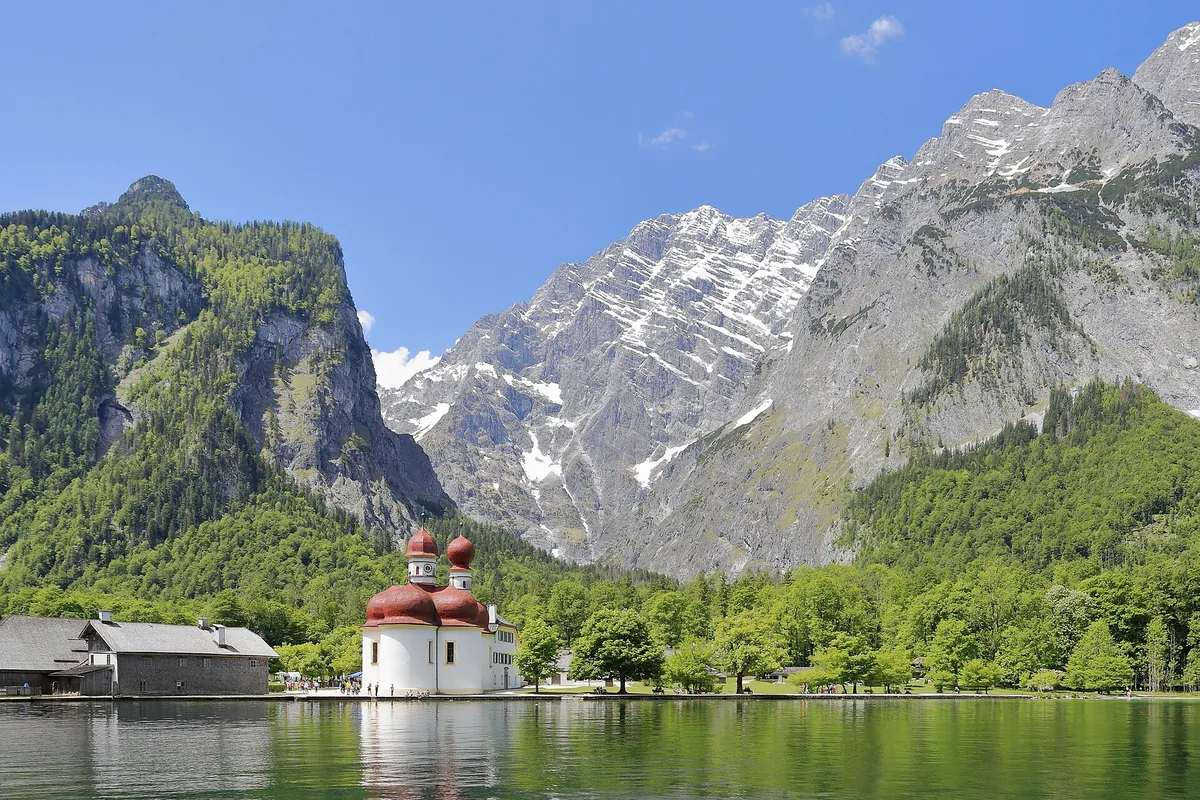
Königssee is the most dramatic lake near Munich, with steep rock walls plunging straight into deep green water. It sits in the Berchtesgaden National Park, and it is also the longest trip in this guide, so treat it as a full and early day.
The usual route is a train from Munich via Freilassing to Berchtesgaden, which takes around three hours each way according to the city’s tourist information. From Berchtesgaden Hauptbahnhof, local buses run to the lake in a short ride, with several lines serving the stop, so check the Königssee public transport page before you go. Because the lake sits near Salzburg, some visitors combine it with an overnight stay.
Electric boats are the highlight, as engines are not allowed on the lake. Boats cross to St. Bartholomä, a pilgrimage church with red onion domes at the foot of the Watzmann mountain, in about 35 to 40 minutes. The church is reachable only by boat or on a long hike, and the one stop makes for a simple half-day plan: take the boat out, have a drink or walk, and take the boat back.
If you have more energy, the walk from the Salet landing stage up to the Obersee, a smaller lake, is a classic hike, although you should check conditions and boat times first.
- How to get there: Train from Munich to Berchtesgaden via Freilassing, then a bus to Königssee and a boat on the lake.
- How long to spend: A full day, or a night in Berchtesgaden if you want to avoid rushing.
- Best time to go: Summer and early autumn. Check boat operation in winter.
- Tip: Check the last boat back and the last train from Berchtesgaden, as this is the day trip with the least slack in the schedule.
How to pick the right day trip from Munich
Start with how long you want to travel. For a half day, choose Lake Starnberg, Dachau or Augsburg. For a full day with a short journey, try Nuremberg, Regensburg or Salzburg. Neuschwanstein, the Zugspitze and Herrenchiemsee take longer and need advance planning, and Königssee is the longest of all.
Then think about what you want to see. Castle and palace fans should choose Neuschwanstein or Herrenchiemsee. Mountain lovers should choose the Zugspitze or Königssee. City explorers can pick Salzburg, Nuremberg or Regensburg, and travellers interested in history will find plenty in Augsburg and at the Dachau memorial.
Finally, check the weather. Mountain and lake trips depend on clear skies, while city trips work in almost any conditions. Many visitors keep one city trip as their rainy-day plan. If you are building a longer Germany trip, our guide to the best places to visit in Germany helps you choose where to go after Bavaria.
How Many Days Do You Need? A 3-Day Munich Day Trips Itinerary
Three days give you a mix of landscapes and cities without rushing, and the plan keeps each day to one direction so travel time stays realistic. It is also available as a free printable PDF.
Day 1: Fairy-tale Bavaria
Take an early train to Füssen for Neuschwanstein Castle, with your timed tour booked in advance. After the castle, walk up to the bridge viewpoint if conditions allow, then have lunch in Hohenschwangau or Füssen. Return to Munich in the evening.
Day 2: History and old towns
Catch a fast train to Nuremberg and spend the morning in the old town and the Imperial Castle. In the afternoon, visit the Documentation Centre at the Rally Grounds if you want the history. If you prefer a gentler day, swap Nuremberg for Regensburg and stroll across the Stone Bridge and around the cathedral.
Day 3: Lakes and mountains
For a relaxed finish, take the S6 to Lake Starnberg and travel by boat to Berg or Possenhofen. If the weather is clear and you want a big view, go to Garmisch-Partenkirchen instead and ride up the Zugspitze. For a quick trip abroad, Salzburg is also a good last day.
Getting around from Munich
Munich Hauptbahnhof is the hub for every trip in this guide. Regional trains, long-distance trains and the S-Bahn all leave from or near the station, and the DB Navigator app shows timetables and tickets. The Bayern-Ticket covers regional trains, S-Bahn and many buses within Bavaria, and on some cross-border regional routes such as Salzburg, but it does not cover long-distance trains. Check the rules for your exact route.
For Dachau and Lake Starnberg, a Munich public transport ticket may cover the whole trip, so check the zones. Some trips, such as the Zugspitze and Königssee, involve separate tickets for cable cars, cog railways or boats. Driving is possible, but parking at popular spots such as Eibsee and Neuschwanstein fills up fast in summer, and trains are usually the easier option.
How much does a day trip from Munich cost?
Costs vary a lot between trips, and we do not quote exact prices because they change. As a rough guide, budget trips include Lake Starnberg, Augsburg and Dachau, where the transport is short and the memorial is free to enter. Mid-range trips include Salzburg, Nuremberg and Regensburg, where the main cost is the train fare and lunch. Higher-cost trips include the Zugspitze, Herrenchiemsee, Neuschwanstein and Königssee, which add cable car, ferry or timed-tour tickets.
To save money, travel with a Bayern-Ticket where it is valid, book regional tickets early, and bring a picnic for lakes and mountains. Check each official website for current prices before you go.
Where should you stay in Munich?
Stay near Munich Hauptbahnhof if you plan several day trips, because you can walk to the platforms and many hotels are within a few minutes. The old town around Marienplatz suits first-time visitors and is a short S-Bahn ride from the station. Maxvorstadt and the university area are lively, with museums and cafes, and Haidhausen is quieter and residential, with good restaurants and easy S-Bahn links. If you prefer a smaller place, you can also base yourself in Augsburg or Salzburg for some trips.
What should you know before you go?
Check timetables and ticket rules a few days ahead, particularly for timed tours at Neuschwanstein and Herrenchiemsee. Mountain and lake trips depend on the weather, so keep your plans flexible. On Sundays and public holidays, many shops are closed in Germany, so plan lunch and supplies in advance. If you are visiting Salzburg, carry ID in case of border checks.
Frequently Asked Questions
What is the best day trip from Munich?
Neuschwanstein Castle is the most popular day trip, and Salzburg and Nuremberg are the best city options. For mountains, choose the Zugspitze at Garmisch-Partenkirchen. Your best choice depends on whether you want castles, cities or scenery.
Can you visit Neuschwanstein as a day trip from Munich?
Yes, it is a very common day trip by train via Füssen and a local bus. The castle can only be visited on a guided tour at a fixed time, so book your ticket online in advance through the official ticket centre, or arrive early for a limited number of same-day tickets.
Is Salzburg a good day trip from Munich?
Yes, direct regional trains make Salzburg one of the easiest trips and the journey is usually under two hours. Leave early to have time for the fortress, the old town and the Mirabell Gardens.
Which day trips from Munich are closest?
Lake Starnberg, Dachau and Augsburg are the closest, each within about an hour by public transport. They work well as half-day trips or when the weather is uncertain.
Is the Bayern-Ticket worth it for day trips?
It can be, because it covers regional trains and many local buses within Bavaria for a day, and it can work on some cross-border regional routes. It does not cover long-distance trains, so check the route for each trip.
Can I do two day trips in one day?
Usually not. Closer pairs such as Dachau and Augsburg are possible, but most trips need a full day, and rushing spoils them. It is better to plan one main trip per day.
Plan Your Next Trip from Munich
After a day out, Austria and Bohemia are both within reach of Bavaria, and if you are continuing east, see our guide to the best day trips from Prague for ideas on the next leg of your trip.
Featured image: Photo by -wuppertaler, CC BY 4.0, cropped, via Wikimedia Commons