Last updated: October 2026
London has enough to fill weeks, and our guide to the best places to visit in London is the place to start, but some of England’s most memorable places are only an hour or so away by train. You can spend a morning in the colleges of Oxford or Cambridge, walk through a Georgian spa city, tour a royal castle, stand among prehistoric stones or breathe sea air on chalk cliffs, and still be back in London for dinner.
This guide covers the 10 best day trips from London, with train planning based on National Rail Enquiries, each with a practical box covering how to get there, how long to spend, the best time to go and one tip. After the list you’ll find help choosing, suggested plans, advice on tours, getting around, where to stay and budget guidance.
Quick answer: What are the best day trips from London? The 10 best day trips from London are Oxford, Cambridge, Bath, Windsor, Stonehenge and Salisbury, Brighton, Canterbury, the Seven Sisters, the Cotswolds and Rye. Oxford and Bath are the best all-round choices by train, Windsor and Canterbury suit a shorter outing, and Brighton and the Seven Sisters are the pick for sea air.
Quick comparison: day trips from London at a glance
| Day trip | Best for | London station | Time each way |
|---|---|---|---|
| Oxford | Colleges, museums, history | Paddington or Marylebone | Around 1 hour |
| Cambridge | Colleges and punting | King’s Cross or Liverpool Street | Under 1.5 hours |
| Bath | Roman baths and Georgian streets | Paddington | Around 1.5 hours |
| Windsor | Royal castle | Paddington or Waterloo | Under 1 hour |
| Stonehenge and Salisbury | Prehistoric site and cathedral | Waterloo | Around 1.5 hours to Salisbury |
| Brighton | Seaside and pier | Victoria or London Bridge | Around 1 hour |
| Canterbury | Cathedral and medieval city | St Pancras | Under 1 hour |
| Seven Sisters | Chalk cliffs and coastal walks | Victoria | Around 1.5 hours |
| The Cotswolds | Honey-stone villages | Paddington | Around 1.5 hours to Moreton-in-Marsh |
| Rye | Cobbled medieval town | St Pancras via Ashford | Around 1 to 1.5 hours |
Times are approximate. Check National Rail Enquiries on the day.
1. Oxford

Oxford, home of the oldest university in the English-speaking world, is one of the easiest and most rewarding day trips from London. The city centre is a maze of honey-coloured stone colleges, quiet quadrangles, libraries and spires, all within walking distance of each other.
Highlights include the Radcliffe Camera and the Bodleian Library, the Bridge of Sighs, Christ Church college with its Great Hall and cathedral, and the Ashmolean Museum, which has free entry and a world-class collection. The Pitt Rivers Museum, packed with anthropological objects, is one of the most unusual museums in Britain. For views over the spires, climb the tower of the University Church of St Mary the Virgin or Carfax Tower.
Many colleges open to visitors, but times vary and some charge entry, so check before you go. If you want castles after this, read our guide to the best castles to visit in the UK for more ideas.
- How to get there: Trains from London Paddington or Marylebone take around an hour.
- How long to spend: A full day.
- Best time to go: Weekdays, starting at opening time. Term time is busier but livelier.
- Tip: Book a walking tour led by a local guide to get into colleges and learn the stories behind the buildings.
2. Cambridge
Cambridge is Oxford’s great rival, and many visitors find it more relaxed and compact. Its colleges back onto the River Cam, and the stretch known as the Backs, with lawns running down to the water, is one of the most beautiful scenes in England.
King’s College Chapel, with its fan-vaulted ceiling, is the city’s most famous building. Other highlights include Trinity College, the Mathematical Bridge at Queens’ College and the Fitzwilliam Museum, which has free entry and an outstanding collection of art and antiquities.
The classic Cambridge experience is punting on the river, either on a guided punt tour or by hiring a punt yourself. On a sunny day, it’s hard to beat.
- How to get there: Trains from London King’s Cross or Liverpool Street take under an hour and a half.
- How long to spend: A full day.
- Best time to go: Late spring and summer for punting; mornings for the colleges.
- Tip: Choose a guided punt tour if you’ve never punted before. Steering is harder than it looks.
3. Bath
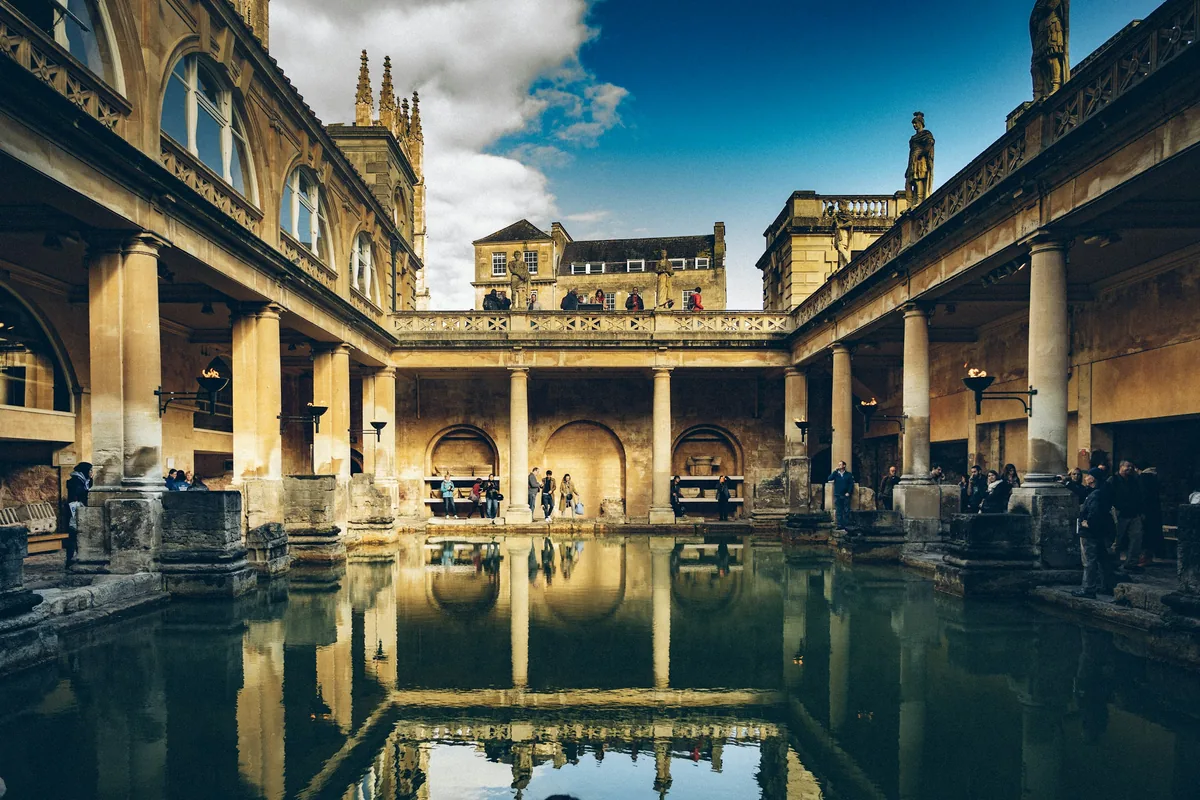
Bath is one of the most beautiful cities in Britain and a UNESCO World Heritage Site. It’s famous for two things: the remarkably preserved Roman Baths, built around natural hot springs, and its elegant Georgian architecture.
At the Roman Baths, you can walk around the original bathing complex, see the steaming Great Bath and learn about Roman life in Britain. Next door, Bath Abbey has a striking fan-vaulted ceiling. Book through the official Roman Baths website, then explore the Georgian city: the sweeping Royal Crescent, the Circus and Pulteney Bridge, which is lined with shops. Jane Austen fans can visit the Jane Austen Centre.
For a modern take on Bath’s spa tradition, Thermae Bath Spa has a rooftop pool filled with naturally warm water and views over the city.
- How to get there: Trains from London Paddington take around 1.5 hours.
- How long to spend: A full day.
- Best time to go: Arrive early for the Roman Baths, the busiest attraction.
- Tip: Book Roman Baths tickets online in advance for a set time slot.
4. Windsor
Windsor Castle is the oldest and largest occupied castle in the world and one of the official residences of the monarch. It’s an easy trip from London and a good choice if you’re interested in the royal family.
Inside, you can visit the State Apartments, with paintings from the Royal Collection, and St George’s Chapel, where many monarchs are buried and royal weddings have taken place. Queen Mary’s Dolls’ House, an incredibly detailed miniature house, is a highlight for many visitors. When the Changing of the Guard takes place, it’s a spectacle with fewer crowds than in London.
The town of Windsor is pleasant to explore, and Eton College is just across the river. The Long Walk through Windsor Great Park offers classic views back to the castle.
- How to get there: Trains from Paddington (changing at Slough) or direct from Waterloo take under an hour.
- How long to spend: Half a day to a full day.
- Best time to go: Morning. Check the castle website for closures, which happen during royal events.
- Tip: Check the Changing of the Guard schedule in advance; it doesn’t happen every day.
5. Stonehenge and Salisbury

Stonehenge is one of the most famous prehistoric monuments in the world. The stone circle on Salisbury Plain was built in stages around 5,000 years ago, and its purpose is still debated. Seeing the giant stones in person is a memorable experience.
The visitor centre has an exhibition on how and why Stonehenge was built, along with reconstructed Neolithic houses. A shuttle bus takes you to the stones, where a path circles the monument.
Combine Stonehenge with Salisbury (see English Heritage’s Stonehenge visitor page for tickets), a city with one of England’s finest medieval cathedrals. It has the tallest spire in Britain and holds one of the four surviving original copies of Magna Carta.
- How to get there: Trains from London Waterloo to Salisbury take around 1.5 hours, then a tour bus runs to Stonehenge. Coach tours from London are also popular.
- How long to spend: A full day, including Salisbury.
- Best time to go: First or last entry slot for fewer crowds.
- Tip: Book timed Stonehenge tickets in advance through English Heritage, especially in summer.
6. Brighton
Brighton is London’s favourite seaside escape: lively, quirky and only an hour away by train. Its long pebble beach and Victorian Palace Pier, with its arcades and funfair rides, are classic British seaside.
Beyond the seafront, the Royal Pavilion is one of the most extraordinary buildings in Britain, a palace built for George IV in an exotic Indian style on the outside with lavish Chinese-inspired interiors. The Lanes, a maze of narrow alleys, are full of jewellers, antique shops and cafés, and the North Laine area is packed with independent shops and vintage stores.
For views along the coast, the British Airways i360 observation tower rises above the seafront.
- How to get there: Trains from London Victoria or London Bridge take around an hour.
- How long to spend: A full day.
- Best time to go: A sunny day from late spring to early autumn.
- Tip: Walk the seafront west towards Hove for a quieter stretch of beach.
7. Canterbury
Canterbury is one of England’s most historic cities, and Canterbury Cathedral, the mother church of the Church of England, is the reason most people come. It was the site of Thomas Becket’s murder in 1170, which made it one of the most important pilgrimage destinations in medieval Europe and inspired Chaucer’s Canterbury Tales.
The cathedral is part of a UNESCO World Heritage Site that also includes St Augustine’s Abbey and St Martin’s Church, widely described as the oldest parish church in England still in use. The medieval city centre, partly enclosed by Roman and medieval walls, has timber-framed buildings and narrow lanes.
On warm days, you can take a punt or river tour along the River Stour through the city.
- How to get there: High-speed trains from St Pancras take under an hour.
- How long to spend: A full day, or half a day for the cathedral and centre.
- Best time to go: Morning, before school groups arrive.
- Tip: Walk part of the city walls for a different view of the centre.
8. Seven Sisters and Beachy Head
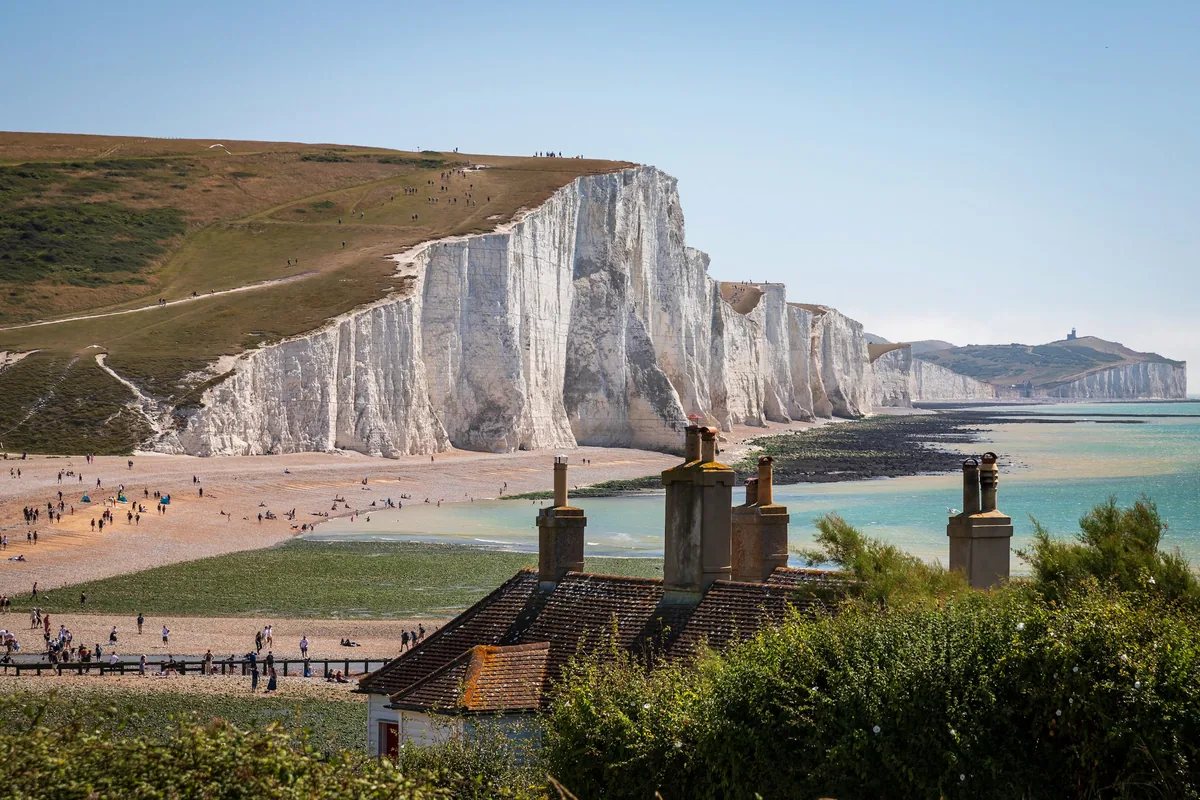
The Seven Sisters are a series of white chalk cliffs on the Sussex coast, within the South Downs National Park. They’re one of the most iconic views in England and make a superb day trip for walkers.
The classic view is from Seaford Head, looking across the Cuckmere estuary to the cliffs, with coastguard cottages in the foreground. From there, coastal paths run over the undulating clifftops towards Birling Gap and on to Beachy Head, the highest chalk sea cliff in Britain, with its red and white lighthouse below.
The cliffs are unstable and erode regularly, so stay well back from the edge and follow any warning signs.
- How to get there: Trains from London Victoria to Seaford or Eastbourne take around 1.5 hours, then local buses run along the coast.
- How long to spend: A full day.
- Best time to go: A clear, dry day. Paths can be muddy after rain.
- Tip: Check bus times for the return journey before you set out, as services along the coast can be infrequent.
9. The Cotswolds
The Cotswolds is an area of rolling hills dotted with villages of honey-coloured stone cottages, and it’s one of the most picturesque parts of England. It’s best known for villages such as Bibury, Bourton-on-the-Water, Castle Combe, Stow-on-the-Wold and Chipping Campden.
The challenge is that the Cotswolds is spread out and public transport between villages is limited. As a day trip from London, it’s best to either join a guided tour or take the train to a hub such as Moreton-in-Marsh and focus on a few nearby villages.
- How to get there: Trains from Paddington to Moreton-in-Marsh or Kingham take around 1.5 hours. Guided tours from London are the easiest way to see several villages.
- How long to spend: A full day.
- Best time to go: Weekdays, especially outside school holidays.
- Tip: Choose two or three villages and spend time walking between them rather than trying to see them all.
10. Rye
Rye is a small hilltop town in East Sussex that feels almost unchanged from centuries past. Its cobbled lanes, especially Mermaid Street, are lined with timber-framed houses and old inns, and it’s one of the most atmospheric towns in southern England.
Climb the tower of St Mary’s Church for views over the town and across the marshes to the sea. Ypres Tower, part of the old defences, houses a small museum. A short bus ride away, Camber Sands is one of the few sandy beaches in the area, backed by dunes.
Rye is small, so it combines well with a beach walk at Camber or a visit to nearby Bodiam Castle if you have a car.
- How to get there: High-speed trains from St Pancras to Ashford, then a local train to Rye; around 1 to 1.5 hours in total.
- How long to spend: Half a day to a full day.
- Best time to go: Weekdays and outside summer weekends.
- Tip: Stop for afternoon tea in one of the old tearooms before heading back.
How to pick the right day trip
- For history and architecture: Oxford, Cambridge, Bath and Canterbury.
- For royalty: Windsor.
- For the coast: Brighton, Seven Sisters or Rye and Camber Sands.
- For countryside: The Cotswolds or the South Downs.
- For a short half-day: Windsor or Canterbury.
Suggested plans for 1, 2 or 3 days
One day: Oxford or Bath, depending on whether you prefer college history or Roman and Georgian architecture.
Two days: Oxford on day one, then Windsor or Brighton on day two for something completely different.
Three days: Add a Stonehenge and Salisbury day, or the Seven Sisters for a coastal walk.
Tours versus going independently
Most of these places are easy to reach by train. Tours make sense for Stonehenge if you want to combine it with Bath or Salisbury without managing connections, and for the Cotswolds, where villages are spread out and buses are infrequent. Going independently gives you more time at each stop and is usually cheaper, especially if you book train tickets in advance.
Getting around
- Trains: Use National Rail Enquiries or the operator’s app to check times and buy tickets. Advance and off-peak tickets are often much cheaper than buying at the station during peak times.
- Railcards: If you’re eligible for a railcard, such as the Two Together or 16-25 Railcard, it can cut fares significantly.
- Coaches: National Express and other coach companies are cheaper but slower than the train.
- Car hire: Useful for the Cotswolds and the coast, but driving out of London can be slow.
For up-to-date timetables and visitor information, check the official sources: National Rail Enquiries and English Heritage: Stonehenge.
Where to stay for easy day trips
If you are building a longer trip, read our guide to the best things to do in London at Christmas for winter visits, and see our Edinburgh day trips guide if you are heading north afterwards.
Stay near the station that serves your most important day trip. Paddington works for Oxford, Bath, Windsor and the Cotswolds. King’s Cross and St Pancras are best for Cambridge, Canterbury and Rye. Victoria suits Brighton and the Seven Sisters, while Waterloo is best for Salisbury and Stonehenge. Central areas such as Bloomsbury and Marylebone are well connected to several of these stations.
Budget guidance
- Shoestring: Book advance or off-peak train tickets, use a railcard if eligible, and focus on free museums such as the Ashmolean and Fitzwilliam, beaches and walks.
- Mid-range: Pay for one or two major attractions, such as the Roman Baths or Windsor Castle, have lunch in a pub, and join a walking tour.
- Comfortable: Book small-group tours to Stonehenge and the Cotswolds, add a punting tour or spa visit, and travel first class on longer journeys.
Frequently Asked Questions
What is the best day trip from London by train?
Oxford and Bath are the best all-round day trips by train, each with direct services and enough to fill a full day. Windsor, Cambridge, Canterbury and Brighton are also excellent and easy to reach.
Can you do Stonehenge and Bath in one day from London?
Yes, many coach tours from London combine Stonehenge and Bath in one day, but it’s long and you’ll have limited time in Bath. Independently, it’s easier to choose one, or to stay overnight in Bath or Salisbury.
Is Oxford or Cambridge better for a day trip?
Both are excellent. Oxford is bigger, with more museums and a grander feel. Cambridge is more compact and relaxed, with punting on the river. Choose Oxford for museums and Cambridge for river scenery.
Can you visit the Cotswolds in a day without a car?
Yes, but it’s easier on a guided tour. By train, go to Moreton-in-Marsh or Kingham and combine a few nearby villages by bus or taxi, checking bus times carefully.
How far is Brighton from London by train?
Around an hour from London Victoria or London Bridge, with frequent trains throughout the day.
Are day tours from London worth it?
Tours are worth it for places that are hard to reach by public transport, such as Stonehenge and the Cotswolds, or when you want to combine several places in one day. For cities with direct trains, going independently is usually better value and more flexible.
Discover More of Britain
If you enjoyed these escapes, plan the rest of your trip with our guide to the best places to visit in London, then head north with our guide to the best day trips from Edinburgh or explore the best Scottish islands to visit.
Featured image: Photo by Simon Hurry on Unsplash