Last updated: October 2026
Edinburgh is one of the easiest cities in Scotland to escape from for the day. Trains run from Waverley station to castles, coastal towns, golf country and the edge of the Highlands, and frequent tours cover the places that are harder to reach without a car.
This guide covers the 10 best day trips from Edinburgh, with how to get there, how long to spend, the best time to go and a tip for each, plus plans for one to three days, where to stay and budget guidance. For wider trip ideas across the country, VisitScotland is the official tourism board.
If you haven’t seen the city itself yet, start with our guide to the best things to do in Edinburgh, then use the trips below to fill the extra days.
Quick answer: What are the best day trips from Edinburgh? The best day trips from Edinburgh are Stirling, St Andrews, Loch Lomond and the Trossachs, the Falkirk Wheel and The Kelpies, Linlithgow Palace, North Berwick and Tantallon Castle, Rosslyn Chapel, Culross and Dunfermline, Melrose and the Scottish Borders, and Glencoe. If you only have one day, choose Stirling: direct trains take under an hour and the castle is one of the finest in Scotland. For Highland scenery, a guided tour to Glencoe or Loch Lomond is worth the long day.
Quick comparison: day trips from Edinburgh at a glance
| Day trip | Best for | Getting there | Time each way |
|---|---|---|---|
| Stirling | Castles and Scottish history | Train | Under 1 hour |
| St Andrews | Coast, golf and university town | Train and bus | Around 1.5 hours |
| Loch Lomond and the Trossachs | Lochs and hills | Train via Glasgow, or tour | Around 2 hours |
| Falkirk Wheel and The Kelpies | Engineering and sculpture | Train and bus | Under 1 hour |
| Linlithgow Palace | Royal palace by a loch | Train | Under 30 minutes |
| North Berwick and Tantallon | Beaches and clifftop ruins | Train | Under 1 hour |
| Rosslyn Chapel | Medieval carvings | Bus | Around 1 hour |
| Culross and Dunfermline | Historic village and abbey | Train and bus | Around 1 hour |
| Melrose and the Borders | Abbeys and rolling hills | Train | Around 1 hour |
| Glencoe | Dramatic Highland scenery | Tour | 3 hours or more |
Journey times are approximate. Always check the latest ScotRail or bus timetable on the day you travel.
1. Stirling
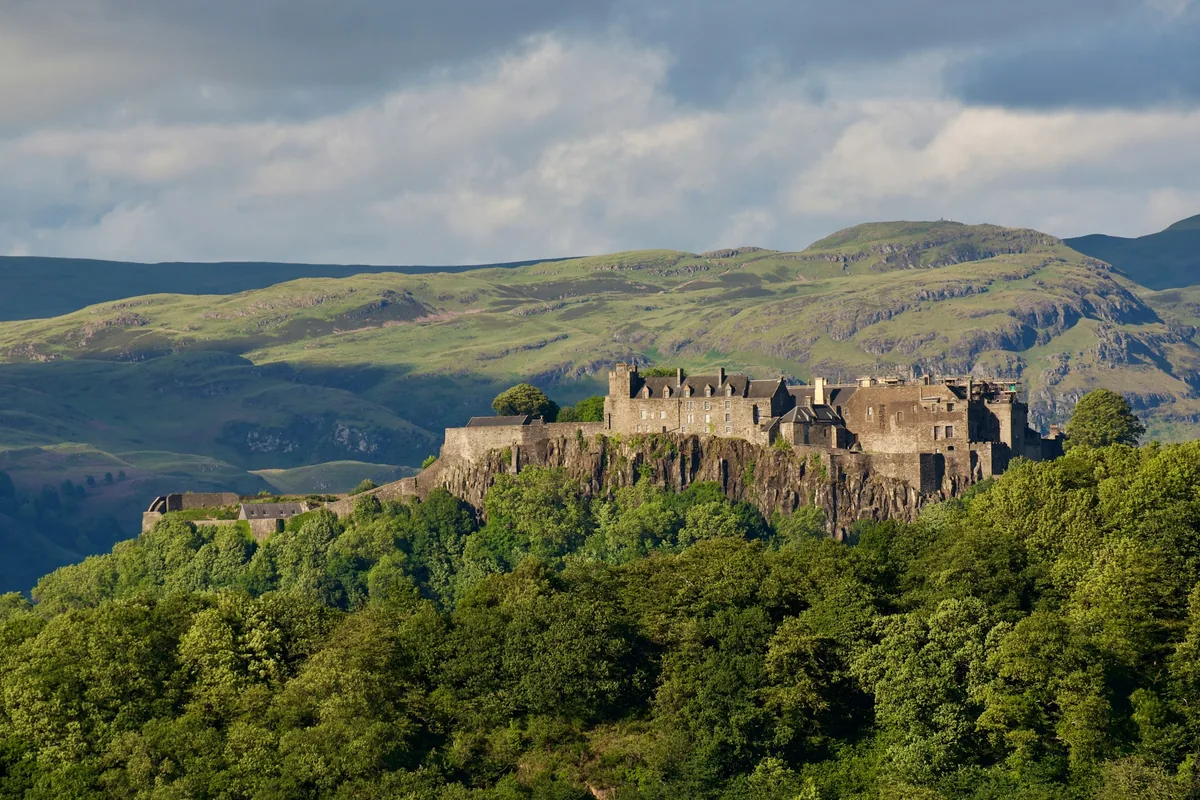
If you only have time for one day trip from Edinburgh, Stirling is the safest choice. The town sits where the Lowlands meet the Highlands. Stirling Castle, perched on a volcanic crag, was a favoured residence of the Stewart kings and queens, and its restored Royal Palace and Great Hall give a clear picture of Renaissance court life.
Just downhill is the Church of the Holy Rude, where James VI was crowned as an infant. Across the river stands the National Wallace Monument, a Victorian tower on Abbey Craig that tells the story of William Wallace and the Battle of Stirling Bridge. The spiral staircase is steep, but the view over the Forth valley is superb.
Bannockburn, site of Robert the Bruce’s famous victory, is a short bus or taxi ride south if you want a third stop.
- How to get there: Direct ScotRail trains from Edinburgh Waverley take under an hour. The castle is about half a mile uphill from the station; its car park is closed to most cars.
- How long to spend: A full day with the Wallace Monument; half a day for the castle alone.
- Best time to go: Arrive for castle opening time. Tour groups tend to build from late morning.
- Tip: Book castle tickets online, where Historic Environment Scotland offers a discount for visitors arriving car-free. The Wallace Monument is a bus ride (services 52 and UL from Goosecroft Road) rather than a stroll from town.
2. St Andrews
St Andrews is best known as the home of golf, but you don’t need to swing a club to enjoy it. This handsome Fife town has a ruined cathedral, a clifftop castle, an ancient university and two beaches.
Start at the cathedral ruins, once by far the largest church in Scotland; the grounds are free to wander. A short walk along the cliffs brings you to St Andrews Castle and its notorious bottle dungeon. Then wander the university quads and the cafés and shops of North Street and Market Street.
West Sands, the long beach used in the opening scenes of Chariots of Fire, stretches out beside the Old Course. Golfers or not, most visitors walk past the 18th green and the Swilcan Bridge.
- How to get there: Take the train from Edinburgh Waverley to Leuchars (around an hour), then the frequent local bus or a taxi for the last few miles. There is no railway station in St Andrews itself.
- How long to spend: A full day. The journey is longer than it looks on a map.
- Best time to go: Late morning to late afternoon, leaving time for a beach walk before you head back.
- Tip: The castle’s underground siege mine and countermine, and St Rule’s Tower at the cathedral, have been closed for maintenance recently, so check with Historic Environment Scotland before you go if they matter to you.
3. Loch Lomond and the Trossachs
For many visitors, Loch Lomond is their first taste of the Highlands. It is the largest body of fresh water in Great Britain by surface area, scattered with wooded islands, and the heart of Loch Lomond and The Trossachs National Park.
The easiest base for a day trip is Balloch at the loch’s southern tip, where you can take a cruise or walk the shoreline at Balloch Castle Country Park. Further up the western shore, the conservation village of Luss has stone cottages, a pebble beach and a pier, though it gets busy in summer.
The Trossachs, east of the loch, is often called the Highlands in miniature. Loch Katrine, with its historic steamship cruises, is the highlight, but it’s difficult to reach on public transport from Edinburgh in a single day. That’s where a guided tour makes sense.
- How to get there: By train to Balloch with a change on the way, usually around Glasgow; allow around two hours each way. Many coach tours from Edinburgh combine Loch Lomond with the Trossachs and Stirling.
- How long to spend: A full day.
- Best time to go: Morning, before the roads and Luss car parks fill up.
- Tip: If you want Loch Katrine as well as Loch Lomond, book a tour or hire a car. Doing both by public transport in one day is not realistic.
4. The Falkirk Wheel and The Kelpies
The Falkirk Wheel is the world’s only rotating boat lift, built to reconnect the Forth and Clyde Canal with the Union Canal. You can ride it on a boat trip run by Scottish Canals.
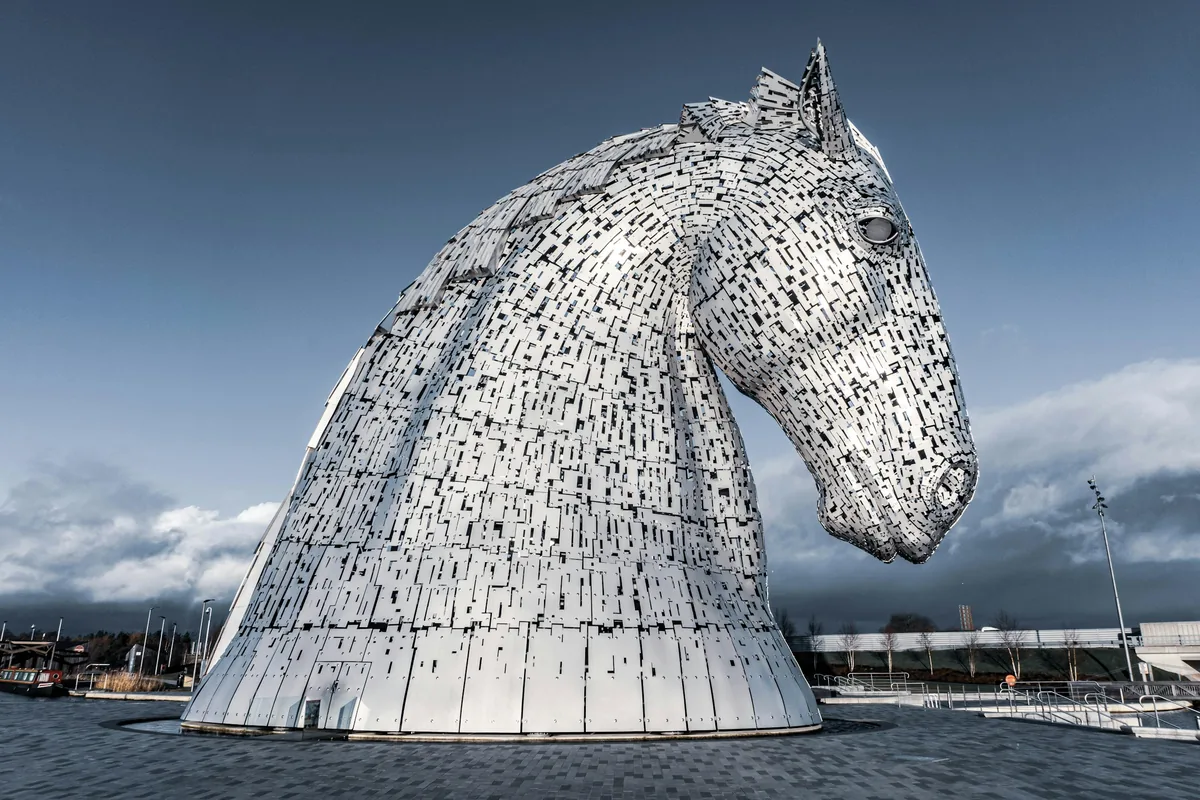
A few miles east, The Kelpies are two 30-metre steel horse heads that rise above the canal at The Helix park. They were inspired by Scotland’s working horses and are especially striking when lit up after dark.
The two sites are not walking distance from each other, so plan on a bus or taxi between them. The Helix has walking and cycling paths, a play area and a café.
- How to get there: Trains from Edinburgh to Falkirk take under an hour; local buses link the town to The Kelpies and the Falkirk Wheel.
- How long to spend: Half a day for both sites, or a relaxed full day with a boat trip.
- Best time to go: Late afternoon at The Kelpies for softer light and fewer people.
- Tip: Boat trip places are limited and can sell out at busy times, so book ahead and check the timetable before you travel if riding the wheel matters to you.
5. Linlithgow Palace
Linlithgow is the quickest of all the day trips from Edinburgh, and one of the most rewarding. Linlithgow Palace, the birthplace of Mary Queen of Scots, is a huge roofless ruin beside a loch, and its scale gives a real sense of how the Stewart court lived.
Inside, you can wander through the courtyard with its ornate fountain, climb to the upper floors and look down into the Great Hall. Next door, St Michael’s Parish Church, with its striking modern spire, is worth a look.
Afterwards, walk the easy circuit of Linlithgow Loch and have lunch on the high street. It pairs well with Stirling or Falkirk.
- How to get there: Frequent trains from Edinburgh Waverley take around 20 minutes. The palace is a short walk from the station.
- How long to spend: Two to three hours, or half a day with the loch walk.
- Best time to go: Any time; mornings are quieter.
- Tip: Book a timed ticket through Historic Environment Scotland’s Linlithgow Palace page. Some rooms, including the king’s bedchamber and the court kitchen, have been closed for conservation work, so check what’s open before you go.
6. North Berwick and Tantallon Castle
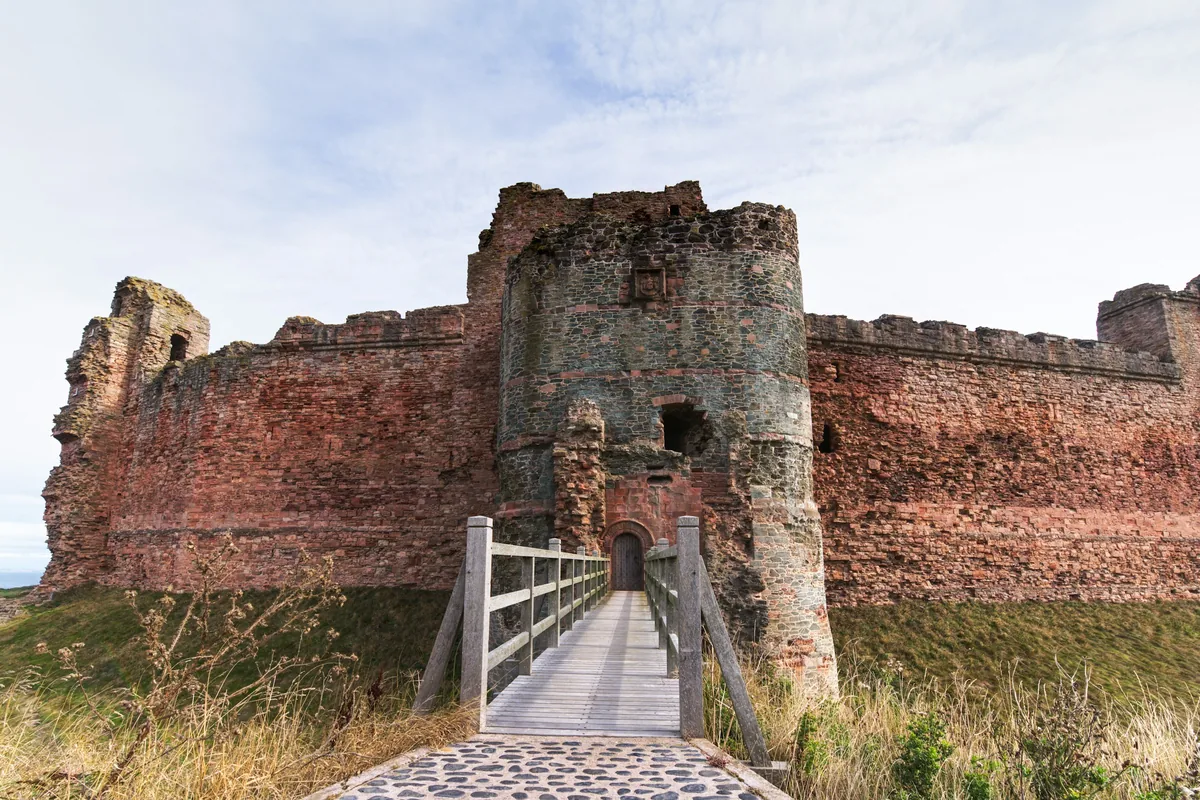
North Berwick is Edinburgh’s favourite seaside escape. This East Lothian town has two sandy beaches, a harbour and independent shops and cafés. The Bass Rock, home to one of the world’s largest northern gannet colonies, sits just offshore.
The Scottish Seabird Centre by the harbour has displays on the local birdlife and runs seasonal boat trips around the Bass Rock. For a short, steep climb with a big view, walk up North Berwick Law, the cone-shaped hill behind the town.
A few miles east, Tantallon Castle is one of the most dramatic ruins in Scotland: a towering red sandstone curtain wall on a clifftop, with the Bass Rock behind it.
If the East Lothian coast appeals, our pick of the best coastal destinations in the UK has more seaside towns for a longer trip.
- How to get there: Direct trains from Edinburgh Waverley to North Berwick take under an hour. Tantallon is a few miles further east by East Coast Buses service 120, taxi or a coastal walk.
- How long to spend: A full day with Tantallon and a boat trip; half a day for the town and beach.
- Best time to go: Late spring to early autumn, when the boat trips run and the gannets are on the Bass Rock.
- Tip: Tantallon has shorter opening hours outside summer and some areas closed for conservation work, so check the Tantallon Castle page on Historic Environment Scotland and the bus timetable before you plan the trip out.
7. Rosslyn Chapel
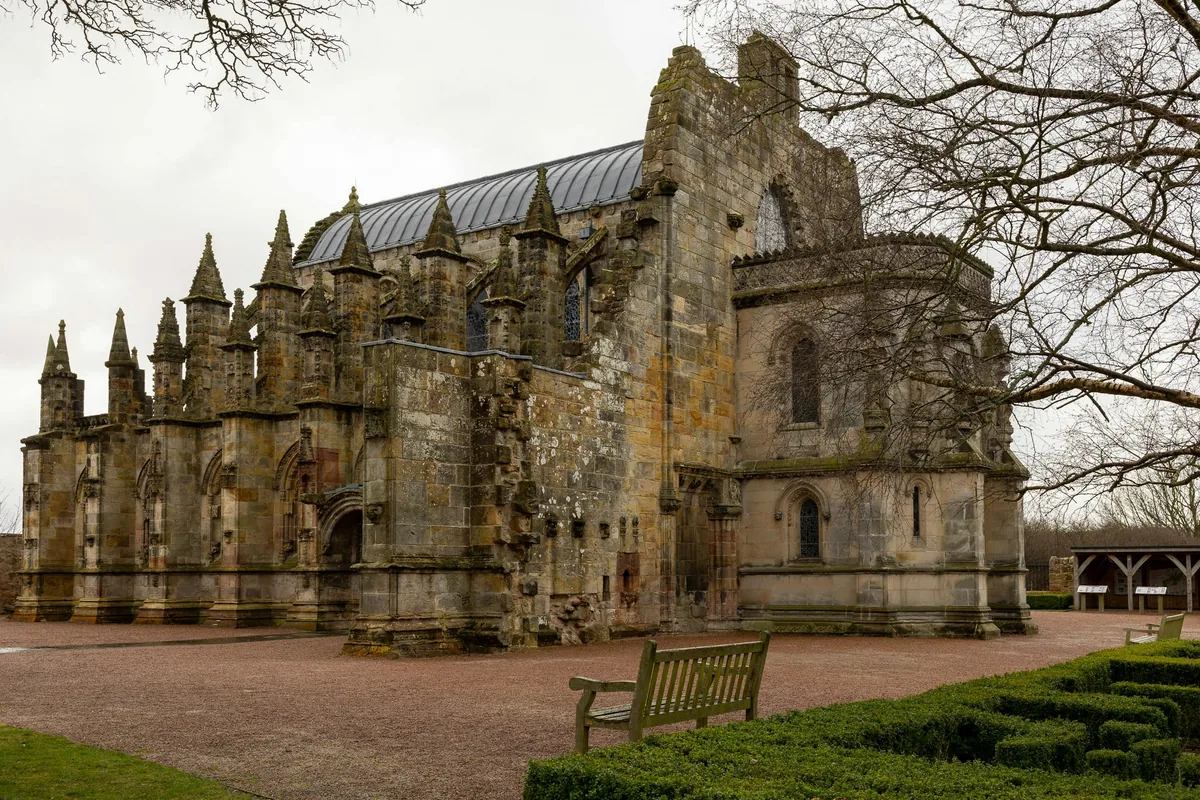
Rosslyn Chapel was founded in 1446 by Sir William St Clair, and it is one of the most richly carved medieval buildings in Scotland. Almost every surface is covered in stone carvings: foliage, angels playing instruments, Biblical scenes and the famous Apprentice Pillar. The Da Vinci Code made it world famous, but the carvings need no legends.
Each visiting slot includes a talk by the chapel’s guides, who explain the history and point out the key carvings. Photography is not allowed inside, so take your time and look closely.
Behind the chapel, paths lead down into Roslin Glen, a wooded gorge along the River North Esk with the ruins of Rosslyn Castle. Adding a walk in the glen turns a short visit into a satisfying half-day trip.
- How to get there: Lothian Buses service 37 from Princes Street or North Bridge takes 45 to 60 minutes. Per Rosslyn Chapel’s travel page, take one showing Penicuik/Deanburn via Roslin and get off by the Original Rosslyn Hotel. Parking is free if you drive.
- How long to spend: Around two hours for the chapel, or half a day with Roslin Glen.
- Best time to go: Weekdays are quieter than summer weekends.
- Tip: Book a timed ticket online in advance, especially in summer, and remember the chapel is a working church that holds Sunday services and occasionally closes for events.
8. Culross and Dunfermline
Culross, on the north shore of the Firth of Forth, is one of the best-preserved 17th-century burghs in Scotland. Its cobbled streets, red pantile roofs and ochre-washed buildings look much as they did when it was a busy trading port, and the village has been used as a filming location for period dramas.
The National Trust for Scotland looks after Culross Palace, a merchant’s house with painted ceilings and a recreated garden. Walk up the hill to the ruins of Culross Abbey for views over the Forth.
Pair Culross with Dunfermline, Scotland’s ancient capital. Dunfermline Abbey is the burial place of Robert the Bruce, and beside it are the ruins of the royal palace where Charles I was born. The town is also the birthplace of Andrew Carnegie, whose cottage is now a museum.
- How to get there: Train from Edinburgh to Dunfermline (under an hour), then a Stagecoach bus from Dunfermline bus station to Culross. A car makes the trip much simpler.
- How long to spend: A full day for both, or half a day for Culross alone.
- Best time to go: Spring to autumn, with late morning at Culross and Dunfermline in the afternoon.
- Tip: Culross Palace opens seasonally (its garden is open all year), the Carnegie museum closes in winter and Dunfermline Palace has been closed while the abbey stays open, so check before you go.
9. Melrose and the Scottish Borders
The Borders Railway, which reopened in 2015, turned the Scottish Borders into an easy day trip. The line runs from Edinburgh to Tweedbank in about an hour, close to two of the region’s best sights.
Melrose Abbey, a red sandstone ruin with remarkably detailed carvings, is believed to be the burial place of Robert the Bruce’s heart. The small town around it has tearooms, shops and gardens, and the three peaks of the Eildon Hills rise behind it if you fancy a proper walk.
Near Tweedbank is Abbotsford, the home of Sir Walter Scott. Its armoury, library and riverside gardens show why Scott is credited with shaping how the world sees Scotland.
- How to get there: ScotRail’s Borders Railway from Edinburgh Waverley to Tweedbank takes about an hour. Abbotsford is around a 20-minute signposted walk from the station; Melrose is under 2 miles away by riverside path or local bus.
- How long to spend: A full day for Melrose and Abbotsford together.
- Best time to go: March to December, when Abbotsford’s house is open; start early to add an Eildon Hills walk.
- Tip: Visit Abbotsford first, then walk along the Tweed to Melrose for the afternoon.
10. Glencoe
Glencoe is the most dramatic landscape you can reach as a day trip from Edinburgh. The glen is a deep valley flanked by towering mountains, including the distinctive pyramid of Buachaille Etive Mòr at its eastern end. It’s also a place of history: in 1692, members of the MacDonald clan were killed here by government troops in the Massacre of Glencoe.
Most visitors see Glencoe on a guided coach tour, which typically crosses Rannoch Moor, stops at viewpoints in the glen and often continues to Fort William or Loch Ness. These are long days, but you avoid driving unfamiliar roads.
As a day trip it’s a scenic overview; stay overnight if you want to walk its trails.
- How to get there: A guided tour from Edinburgh is the most practical option. Driving yourself takes around two and a half to three hours each way without stops.
- How long to spend: A full day of 10 hours or more, much of it on the road.
- Best time to go: Tours leave early in the morning; bring snacks and layers.
- Tip: Choose a smaller-group tour if you can. They tend to stop more often and reach viewpoints that larger coaches can’t.
How to pick the right day trip
- For history: Stirling, Linlithgow Palace, Rosslyn Chapel and Culross.
- For the coast: North Berwick and St Andrews.
- For Highland scenery: Glencoe or Loch Lomond and the Trossachs.
- For a short half-day: Linlithgow, Rosslyn Chapel or North Berwick.
- Without booking a tour: Stirling, Linlithgow, North Berwick, Melrose and the Falkirk Wheel are all straightforward on public transport.
- When a tour helps: Glencoe, the Trossachs and multi-stop days, at the cost of less time at each stop.
Suggested plans for 1, 2 or 3 days of day trips
One day: Go to Stirling. Do the castle in the morning and the Old Town in the afternoon, adding the Wallace Monument if you still have energy.
Two days: Spend day one in Stirling, stopping at Linlithgow on the way back since it’s on the same rail line. On day two, choose between North Berwick or the Borders Railway to Melrose and Abbotsford.
Three days: Add a Highland tour on day three, either Loch Lomond and the Trossachs or a full Glencoe day. Or swap the coach for St Andrews.
Getting around
Train: ScotRail runs services from Edinburgh Waverley to almost every place in this guide. ScotRail scrapped peak fares in 2025, so you no longer need to avoid early trains to get a fair price.
Bus: Lothian Buses covers the city and nearby areas, including Rosslyn Chapel, and contactless payment works on board. Rural buses in Fife, East Lothian and the Borders are run by other operators, so check the timetable for your route.
Car hire: A car makes Culross, Tantallon, the Trossachs and Glencoe much easier. You drive on the left, rural roads can be narrow and winding, and parking in central Edinburgh is limited and expensive.
Where to stay for easy day trips
For day trips by train, stay near Edinburgh Waverley. The Old Town and New Town are both within walking distance of the station. Haymarket, the city’s second station, is a quieter and often cheaper alternative served by many of the same trains, especially those heading west to Stirling, Linlithgow and Glasgow. A central base also suits coach tours, which mostly leave from near Waverley.
Budget guidance
- Shoestring: Stick to places you can reach by train or bus, and choose free sights such as beaches, loch walks, town centres and the St Andrews Cathedral grounds.
- Mid-range: Add paid entry to castles and palaces, a café or pub lunch, and one guided coach tour. If you plan to visit several Historic Environment Scotland sites, compare an Explorer Pass with individual tickets.
- Comfortable: Book small-group or private tours, add boat trips on Loch Lomond or around the Bass Rock, and consider hiring a car for the Highlands or the Fife coast.
Frequently Asked Questions
What is the best day trip from Edinburgh by train?
Stirling is the best all-round day trip by train. Direct services take under an hour, and the town has Stirling Castle, the Old Town and the Wallace Monument.
Can you do Loch Ness as a day trip from Edinburgh?
Yes, but only on a long guided tour of around 12 hours, much of it on the road. Most Loch Ness tours from Edinburgh also pass through Glencoe. If you want time at the loch itself, stay overnight in Inverness or the Great Glen.
Do you need a car for day trips from Edinburgh?
No. Most of the best day trips, including Stirling, Linlithgow, North Berwick, Melrose and Rosslyn Chapel, are easy by train or bus. A car helps for Culross, the Trossachs and Glencoe, but tours cover those too.
Can you visit the Highlands in a day from Edinburgh?
Yes. Guided tours to Glencoe, the Trossachs or Loch Lomond show you Highland scenery in a single day. Expect a long day with a lot of time on the coach.
Is Stirling or St Andrews better for a day trip?
Stirling is better for castles and Scottish history, and it’s quicker to reach by train. St Andrews is better if you want a seaside town with beaches, ruins and a famous golf course.
How many days do you need for day trips from Edinburgh?
Two or three days is enough to cover the highlights. Spend one day in Stirling and Linlithgow, one on the coast or in the Borders, and, if you have a third day, take a Highland tour.
Plan More of Scotland
Pair these trips with our guide to the best things to do in Edinburgh itself, or look further afield with Scotland’s cities worth a visit and the castles we rate most highly across the UK. If the Glencoe tour leaves you wanting more of the west coast, our guide to the best Scottish islands to visit is the natural next step.