Last updated: October 2026
The best beer halls in Munich are the Hofbräuhaus for atmosphere, the Augustiner-Keller for a classic garden, and the Hirschgarten for space. Beer is part of daily life here in a way that’s hard to match anywhere else. The city’s beer halls have been serving its own breweries’ beers for centuries, and in summer, locals head to shady beer gardens under chestnut trees, where long wooden tables fill with friends, families and colleagues. It’s a tradition that’s as much about community as it is about drinking.
This guide covers 10 of the best beer halls and beer gardens in Munich, each with a practical box covering how to get there, how long to spend, the best time to go and one tip. Further down you’ll find what to order, how beer gardens work, suggested routes, seasons and festivals, where to stay, getting around and budget guidance.
Opening hours and seasons vary, particularly for beer gardens, which depend on the weather. Check each venue’s website before you go, and use the official München Tourismus site for current visitor information. If you are building a wider German city break, our guide to the best places to eat in Berlin is a good next stop.
Quick answer: What are the best beer halls and beer gardens in Munich? The top picks are the Hofbräuhaus, Augustiner-Keller, Augustiner Bräustuben, Chinesischer Turm, Hirschgarten, Löwenbräukeller, Paulaner am Nockherberg, the Viktualienmarkt beer garden, Seehaus and Weisses Bräuhaus. For a first visit, pair the Hofbräuhaus for the classic hall experience with the Augustiner-Keller or Hirschgarten for a proper chestnut-shaded beer garden.
Quick list: Munich beer halls and beer gardens
| Venue | Type | Area | Brewery |
|---|---|---|---|
| Hofbräuhaus | Beer hall | Altstadt | Hofbräu |
| Augustiner-Keller | Beer garden and cellar | Near Hauptbahnhof | Augustiner |
| Augustiner Bräustuben | Beer hall | Schwanthalerhöhe | Augustiner |
| Chinesischer Turm | Beer garden | English Garden | Hofbräu |
| Hirschgarten | Beer garden | Nymphenburg area | Augustiner |
| Löwenbräukeller | Beer hall and garden | Maxvorstadt | Löwenbräu |
| Paulaner am Nockherberg | Beer hall and garden | Au | Paulaner |
| Viktualienmarkt beer garden | Beer garden | Altstadt | Rotating Munich breweries |
| Seehaus | Beer garden | English Garden | Paulaner |
| Weisses Bräuhaus | Beer hall | Altstadt | Schneider Weisse |
1. Hofbräuhaus
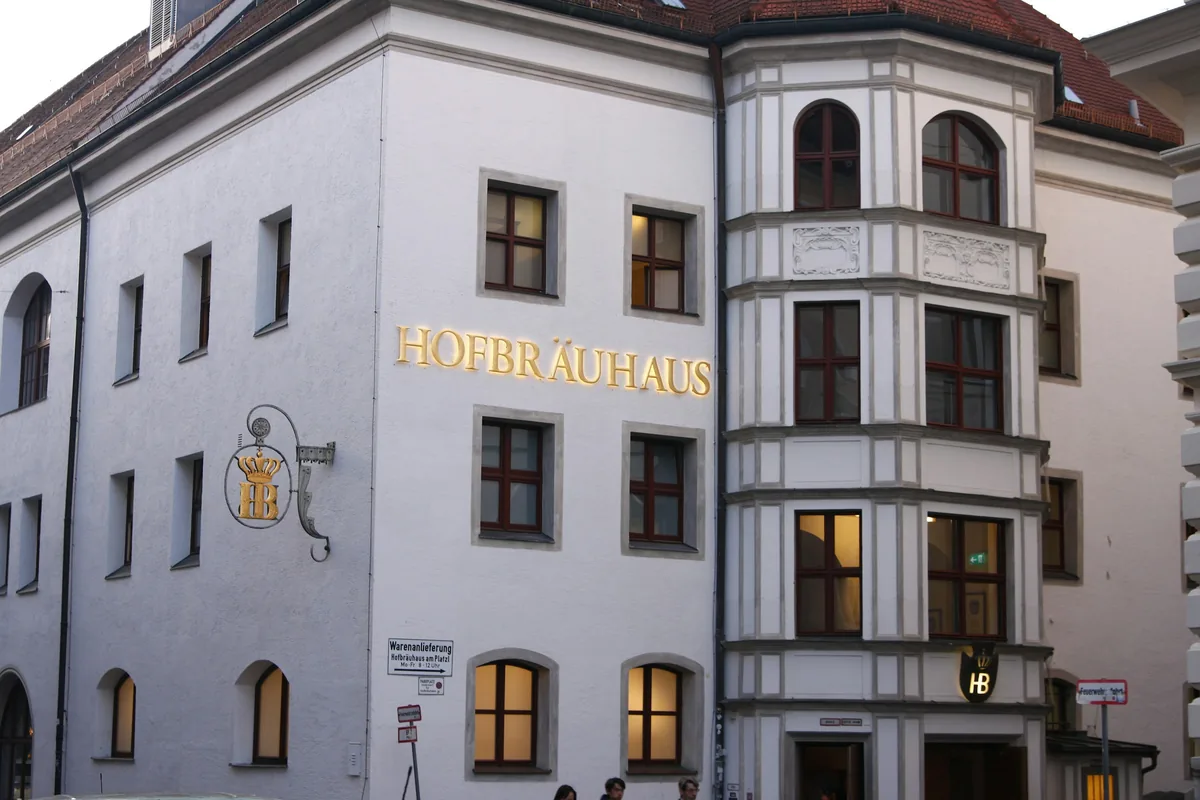
The Hofbräuhaus is the most famous beer hall in the world. Founded in the 16th century as the royal brewery of the Dukes of Bavaria, it’s a huge, noisy hall with vaulted, painted ceilings, long wooden tables and a brass band playing traditional music.
It’s undeniably touristy, but it’s also an essential Munich experience. Regulars still have their own reserved tables (Stammtisch), some with personal beer mugs locked in a rack by the entrance. The menu is classic Bavarian: roast pork, sausages, pretzels and pork knuckle.
Upstairs is the Festsaal, a grand hall used for events, and there’s a courtyard beer garden in summer.
- How to get there: On Platzl in the Altstadt, a short walk from Marienplatz.
- How long to spend: One to two hours.
- Best time to go: Weekday afternoons are calmer than evenings.
- Tip: Seats are shared, so ask “Ist hier noch frei?” (is this free?) before sitting at a table, and avoid reserved Stammtisch tables.
2. Augustiner-Keller
Many locals consider Augustiner the best of Munich’s breweries, and the Augustiner-Keller is one of the city’s most loved beer gardens. Its large, leafy garden under chestnut trees seats thousands of people, and on a summer evening it’s full of locals relaxing after work.
There’s a self-service area where you can bring your own food, as is traditional, and a served area with full table service. Indoors, there’s a beer hall and historic cellars for cooler weather.
Augustiner is known for serving some of its beer from wooden barrels (Holzfass), which many drinkers believe gives a smoother taste.
- How to get there: On Arnulfstraße, a short walk from Munich Hauptbahnhof.
- How long to spend: Two hours or more on a summer evening.
- Best time to go: A warm early evening.
- Tip: Look for beer served from the wooden barrel and try it alongside a regular pour.
3. Augustiner Bräustuben
The Augustiner Bräustuben is a traditional beer hall next to the Augustiner brewery, and it’s one of the most authentic beer halls in Munich. It’s popular with locals and has a cosy, wood-panelled interior, and the building is said to have once been a stable for the brewery’s horses, which pulled the beer wagons.
The food is classic, hearty and good value, with roast pork, pork knuckle and sausages. It is often better value than the more famous beer halls in the centre.
- How to get there: On Landsberger Straße, near the Schwanthalerhöhe U-Bahn station or Hackerbrücke S-Bahn.
- How long to spend: One to two hours.
- Best time to go: Dinner; it gets very busy in the evening.
- Tip: Book a table for groups, especially during Oktoberfest season, when the Theresienwiese is close by.
4. Chinesischer Turm
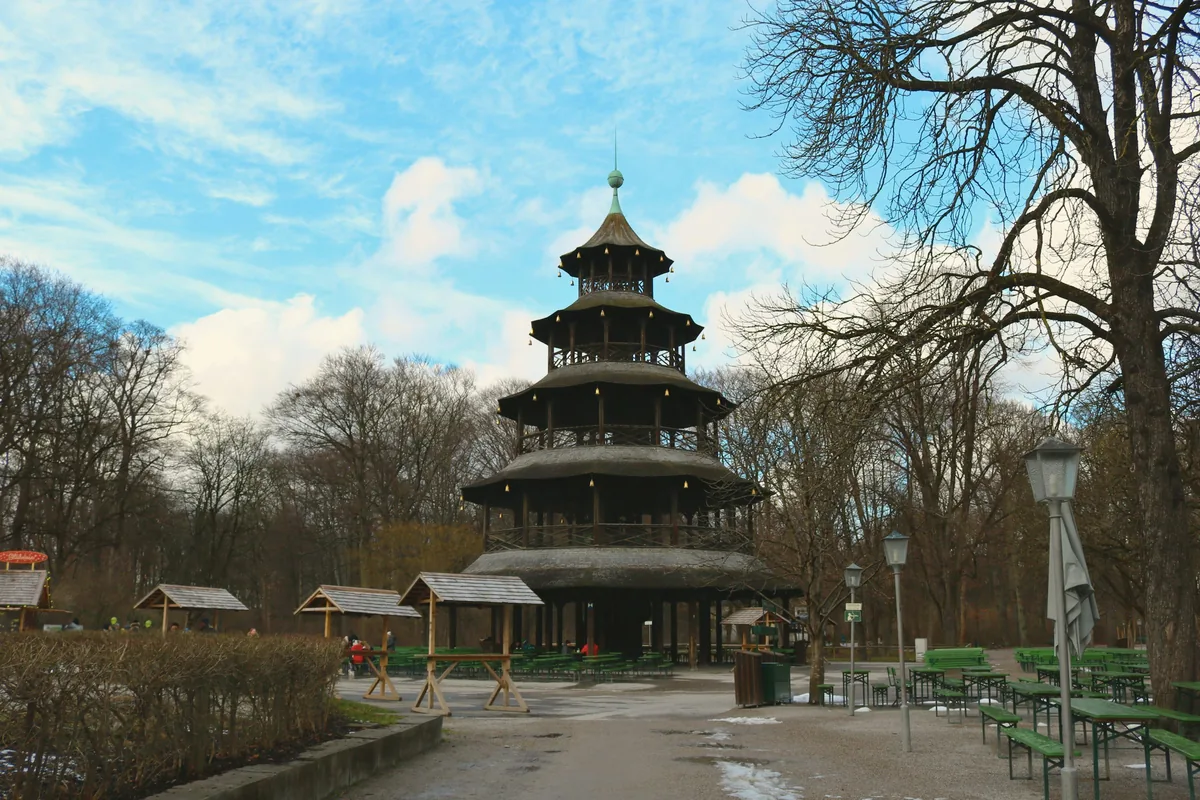
The Chinesischer Turm (Chinese Tower) beer garden is set around a wooden pagoda in the middle of the English Garden, one of the largest city parks in the world. It’s one of Munich’s biggest and most famous beer gardens, with thousands of seats.
On summer weekends, a brass band often plays from the tower, and the atmosphere is lively and family-friendly. Food stalls sell roast chicken, pretzels, spare ribs and Obatzda, a spiced cheese spread.
Combine your visit with a walk through the park, including a stop at the Eisbach, where surfers ride a standing wave.
- How to get there: In the English Garden, a walk from the Universität or Giselastraße U-Bahn stations, or by bus.
- How long to spend: Two hours, plus time in the park.
- Best time to go: A sunny weekend afternoon for the full atmosphere.
- Tip: Walk to the Eisbach surfers near the southern end of the park before or after your visit.
5. Hirschgarten
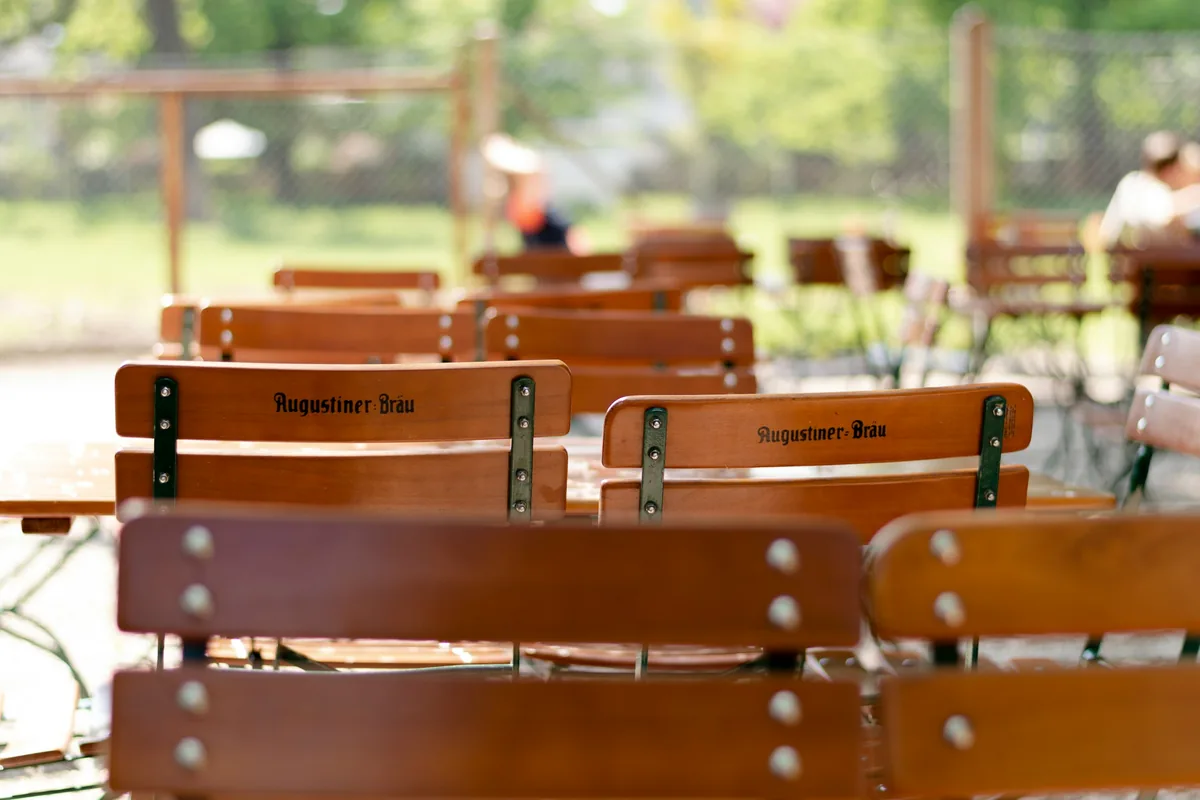
The Hirschgarten is generally described as Munich’s largest beer garden, with room for thousands of guests. It’s set in a former royal hunting ground near Nymphenburg Palace, and a deer enclosure (Hirsch means deer) is still part of the grounds.
It’s very popular with local families and feels less touristy than the beer gardens in the centre. There’s a large self-service area, a playground and plenty of space to spread out.
Visit Nymphenburg Palace, the summer residence of Bavaria’s rulers, and its gardens before heading to the Hirschgarten.
- How to get there: S-Bahn to Laim or Hirschgarten station, or tram to the Romanplatz area.
- How long to spend: Two hours or more.
- Best time to go: A summer afternoon, ideally after visiting Nymphenburg Palace.
- Tip: Bring your own food for the self-service area, as locals do, and buy your drinks there.
6. Löwenbräukeller
The Löwenbräukeller is a grand beer hall and beer garden with a castle-like exterior, serving Löwenbräu beer, whose lion symbol is one of the best known in Munich. Inside, a huge festival hall hosts events, and the traditional restaurant serves Bavarian food in wood-panelled rooms.
In summer, its beer garden is a lively place to sit outside. It’s less crowded with tourists than the Hofbräuhaus, and it’s a good option if you’re exploring the museums in the Maxvorstadt area nearby.
- How to get there: At Stiglmaierplatz, which has its own U-Bahn station.
- How long to spend: One to two hours.
- Best time to go: Dinner or a summer evening in the garden.
- Tip: Visit the museums of the Kunstareal, such as the Alte Pinakothek, beforehand.
7. Paulaner am Nockherberg
Paulaner am Nockherberg stands on the hill where the Paulaner brewery, founded by monks, brewed for centuries. Large-scale production has since moved elsewhere in Munich, but the site keeps a beer hall with a small in-house brewery and a large beer garden above the Isar River.
It’s especially famous for the Starkbierfest (strong beer festival) held during Lent, when Paulaner serves its strong Salvator beer, originally brewed by monks to sustain them through fasting. The festival opens with a televised event in which politicians are teased by comedians.
The rest of the year, it’s a relaxed spot for beer and Bavarian food, and the garden opens in good weather.
- How to get there: In the Au district, reachable by public transport or a walk across the Isar from the city centre. Check MVV for the best route.
- How long to spend: One to two hours.
- Best time to go: During Starkbierzeit in spring, or a summer evening in the garden.
- Tip: Ask whether an in-house or unfiltered beer is on tap, as the house beers can vary.
8. Viktualienmarkt beer garden
The Viktualienmarkt is Munich’s famous open-air food market, and in its centre, under the trees beside the maypole, is a beer garden. It’s unusual because it serves beers from Munich’s six major breweries in rotation, so you can try a different one each time you visit.
It’s a perfect stop while exploring the old town. Buy snacks, cheese, sausages or pretzels from the market stalls, then sit down with a beer in the self-service garden.
- How to get there: Next to Marienplatz in the Altstadt.
- How long to spend: An hour.
- Best time to go: Lunchtime or early afternoon.
- Tip: Check the sign to see which brewery’s beer is currently being served.
9. Seehaus
The Seehaus beer garden sits on the shores of the Kleinhesseloher See, a lake in the northern part of the English Garden. It’s quieter and more relaxed than the Chinesischer Turm, and the lakeside setting is one of the most beautiful in Munich.
In the warmer months you can usually hire a pedal boat or rowing boat on the lake (check the boat hire for current times), and the beer garden has both self-service and restaurant areas. It’s a lovely place to end a long walk through the park.
- How to get there: In the northern English Garden, a walk through the park from the nearest U-Bahn or bus stop. Check MVV for the best route.
- How long to spend: One to two hours.
- Best time to go: Late afternoon or sunset on a summer day.
- Tip: Walk from the Chinesischer Turm to the Seehaus through the park to see both.
10. Weisses Bräuhaus (Schneider Bräuhaus)
The Weisses Bräuhaus is the place to try Bavarian wheat beer (Weissbier). Run by the Schneider brewery, which has specialised in wheat beer since the 19th century, it’s a traditional beer hall in the old town with a loyal local following.
Its signature beer is Schneider Weisse Tap 7, an amber wheat beer, and its Aventinus (Tap 6) is a dark, strong wheat beer known as a Weizenbock. The kitchen is known for traditional Bavarian food, including Weisswurst, the white sausage traditionally eaten before noon with sweet mustard and a pretzel.
- How to get there: On Tal, a short walk from Marienplatz.
- How long to spend: One to two hours.
- Best time to go: Late morning, for a traditional Weisswurst breakfast.
- Tip: The Weisswurst skin is not usually eaten, so peel it or ask the staff to show you how locals do it.
Beer basics: what to order in Munich
- Helles: a pale, light lager and Munich’s everyday beer.
- Weissbier (Weizen): cloudy wheat beer with banana and clove notes.
- Dunkel: a dark lager with malty, bread-like flavours.
- Radler: beer mixed with lemonade, popular on hot days.
- Russ: wheat beer mixed with lemonade.
- Starkbier: strong beer brewed for Lent.
- Mass: a one-litre mug, the standard measure in beer gardens and at Oktoberfest. Smaller half-litre glasses are also common.
How Munich beer gardens work
Traditional Bavarian beer gardens are a unique part of Munich life, with their own customs:
- Bring your own food: In the self-service area of a traditional beer garden, you’re allowed to bring your own food, a long-standing Bavarian custom. You buy your drinks from the beer garden. Tables with tablecloths are usually for table service only.
- Self-service: Pick up a tray, choose your food at the counters, and collect your beer from the bar.
- Mug deposit: Some beer gardens charge a deposit (Pfand) on mugs, which you get back when you return them.
- Shared tables: Tables are shared, so join others if there’s space.
- Weather: Beer gardens open when it’s warm and dry enough, mostly from spring to early autumn.
Seasons and festivals
- Starkbierzeit (spring): The strong beer season during Lent, especially at Paulaner am Nockherberg.
- Beer garden season (spring to early autumn): Most beer gardens open fully when the weather is warm.
- Oktoberfest (late September to early October): The world’s largest beer festival, held on the Theresienwiese (official Oktoberfest site). Beer halls and hotels get very busy.
- Winter: Beer halls are the place to be, with hearty food and warm interiors. Visiting in December? Our guide to the top Christmas markets in Europe helps you plan a festive trip around the beer halls, and our pick of European winter destinations covers other cold-weather city breaks.
Check official sources for exact dates each year.
Suggested routes for 1, 2 or 3 days
One day: Start with a Weisswurst breakfast at the Weisses Bräuhaus, stop at the Viktualienmarkt beer garden at lunchtime, and visit the Hofbräuhaus in the afternoon. Finish with dinner at the Augustiner-Keller.
Two days: Spend day two in the English Garden, walking from the Eisbach surfers to the Chinesischer Turm and on to the Seehaus.
Three days: Visit Nymphenburg Palace and the Hirschgarten, then have dinner at the Augustiner Bräustuben or the Löwenbräukeller.
Where to stay
- Altstadt (old town): close to the Hofbräuhaus, Viktualienmarkt and Weisses Bräuhaus.
- Around Hauptbahnhof: convenient for transport and the Augustiner-Keller.
- Maxvorstadt and Schwabing: close to the English Garden, museums and the Löwenbräukeller.
- Ludwigsvorstadt: near the Theresienwiese, useful during Oktoberfest.
Getting around
Munich has an efficient public transport system of U-Bahn, S-Bahn, trams and buses. Most of the city centre is walkable, and cycling is a great way to get around, especially to the beer gardens in the English Garden and around Nymphenburg.
For up-to-date timetables and visitor information, check the official sources: München Tourismus and MVV (Munich public transport).
Budget guidance
- Budget: Choose beer gardens’ self-service areas and bring your own food, as the locals do.
- Mid-range: Eat traditional Bavarian food in beer halls and enjoy a few beers.
- Comfortable: Book a table in the served areas or a beer hall restaurant, and visit during festivals.
Carry some cash, as some beer gardens and stalls still prefer it. For more food-focused budgeting ideas on a multi-city trip, see where to eat in Barcelona for a very different tapas-led approach.
Frequently Asked Questions
What is the most famous beer hall in Munich?
The Hofbräuhaus is the most famous beer hall in Munich and probably the world. It dates back to the 16th century and has a lively atmosphere with live brass band music.
Can you bring your own food to Munich beer gardens?
Yes, in the self-service areas of traditional beer gardens. It’s a long-standing Bavarian custom. Drinks must be bought from the beer garden, and served areas with tablecloths are for table service.
When are Munich beer gardens open?
Most beer gardens open from spring to early autumn, when the weather is warm and dry. Opening times depend on the weather, so check before you go.
What is the difference between a beer hall and a beer garden?
A beer hall is an indoor venue serving beer and food, open all year. A beer garden is outdoors, usually under chestnut trees, and is mainly open in the warmer months.
Is Hofbräuhaus worth visiting?
Yes. While it’s touristy, it’s an iconic Munich experience with historic architecture, live music and a lively atmosphere. Visit in the afternoon for a calmer experience.
What beer should you order in Munich?
Start with a Helles, Munich’s classic pale lager. Try a Weissbier (wheat beer) and a Dunkel (dark lager) too. If it’s hot, order a Radler, which is beer mixed with lemonade.
Featured image: Photo by Max Kratzer on Unsplash