Last updated: October 2026
The Algarve has some of the most beautiful beaches in Europe, with golden sandstone cliffs, sea caves, rock arches and long sandy islands. Portugal’s southern coast enjoys around 300 days of sunshine a year, making it a favourite for beach holidays from spring to autumn.
The coast changes a lot from west to east. The western Algarve is wild and windy with Atlantic surf, the central Algarve is famous for its cliffs and coves, and the eastern Algarve has calm, sandy barrier islands.
Here are the top 10 Algarve beaches, with practical tips for each. The official Visit Algarve site has more regional information.
Quick answer: What are the best beaches in the Algarve? Our top 10 are Praia da Marinha, Praia de Benagil and the Benagil Cave, Praia da Falésia, Praia Dona Ana, Praia do Camilo, Praia de Odeceixe, Praia da Rocha, Praia da Ilha de Tavira, Praia do Barril and Praia da Bordeira. Praia da Marinha is often called the most beautiful, Benagil has the famous sea cave, Praia da Falésia is best for long walks and Ilha de Tavira is best for calm water and soft sand. May, June and September are the best months to go.
Top 10 Algarve Beaches at a Glance
| # | Destination | Best for |
|---|---|---|
| 1 | Praia da Marinha | Scenery and snorkelling |
| 2 | Praia de Benagil and the Benagil Cave | Iconic photos |
| 3 | Praia da Falésia | Long walks and space |
| 4 | Praia Dona Ana | Swimming near town |
| 5 | Praia do Camilo | Photography |
| 6 | Praia de Odeceixe | Families and surfers |
| 7 | Praia da Rocha | Facilities and nightlife |
| 8 | Praia da Ilha de Tavira | Sandy beaches and calm water |
| 9 | Praia do Barril | Something different |
| 10 | Praia da Bordeira | Surfing and wild nature |
1. Praia da Marinha
Praia da Marinha is often ranked among the most beautiful beaches in Europe, with honey-coloured cliffs, rock arches and clear water perfect for snorkelling.
The beach sits at the bottom of a staircase from the clifftop car park, which fills up early in summer. From here, you can join the Seven Hanging Valleys Trail, a clifftop walk of around 6 km to Praia do Vale Centeanes, passing Benagil along the way.
The trail has very little shade, so start early or late in the day and take plenty of water. Nearby, the town of Carvoeiro has its own small beach and the Algar Seco rock formations, a maze of natural arches and pools carved into the cliffs.
- Getting there: Drive to the clifftop car park, around ten minutes from Carvoeiro.
- Time needed: Half a day, or a full day with the clifftop trail.
- Best time to go: Early morning, before the car park fills up.
- Insider tip: Bring a snorkel to explore the rocks at either end of the beach.
Best for: scenery and snorkelling.
2. Praia de Benagil and the Benagil Cave
The Benagil Cave is the Algarve’s most famous sight, a vast sea cave with a hole in its roof that lets sunlight pour onto a hidden beach. It is reached from the small Praia de Benagil.
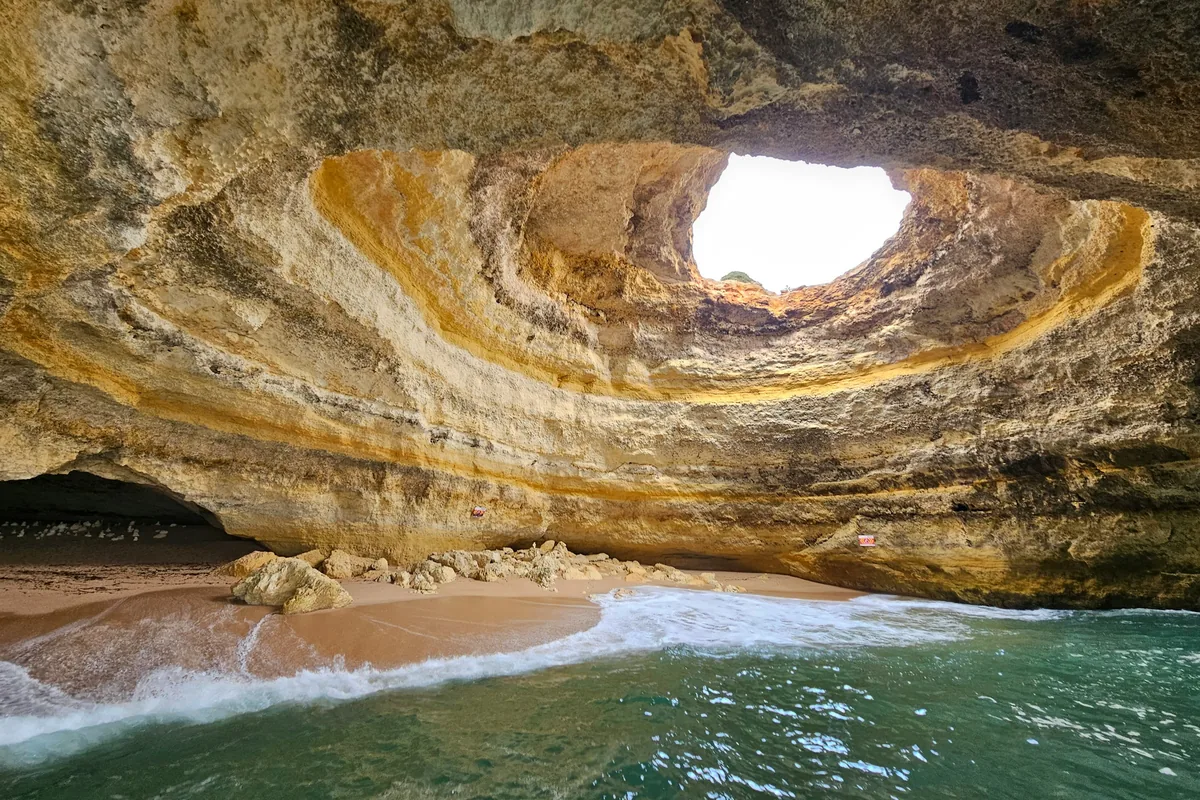
Rules for visiting have tightened recently to protect the cave and manage crowds, and stepping onto the beach inside the cave is no longer permitted. Most visitors now see it on a boat or guided kayak tour from Benagil, Portimão or Armação de Pêra. Check current regulations before you book.
Tours visit the cave along with other grottoes and rock arches along this stretch of coast, many of which are beautiful in their own right. The sea is usually calmest in the morning, which is the best time for kayak trips.
- Getting there: Benagil is a small village between Carvoeiro and Armação de Pêra. Boat tours also leave from Portimão and Armação de Pêra.
- Time needed: One to two hours for a boat or kayak tour.
- Good to know: Tours are cancelled in rough seas, so keep your plans flexible.
Best for: iconic photos.
3. Praia da Falésia
Praia da Falésia is a spectacular beach stretching for around 6 km below red, orange and white cliffs between Vilamoura and Olhos de Água.
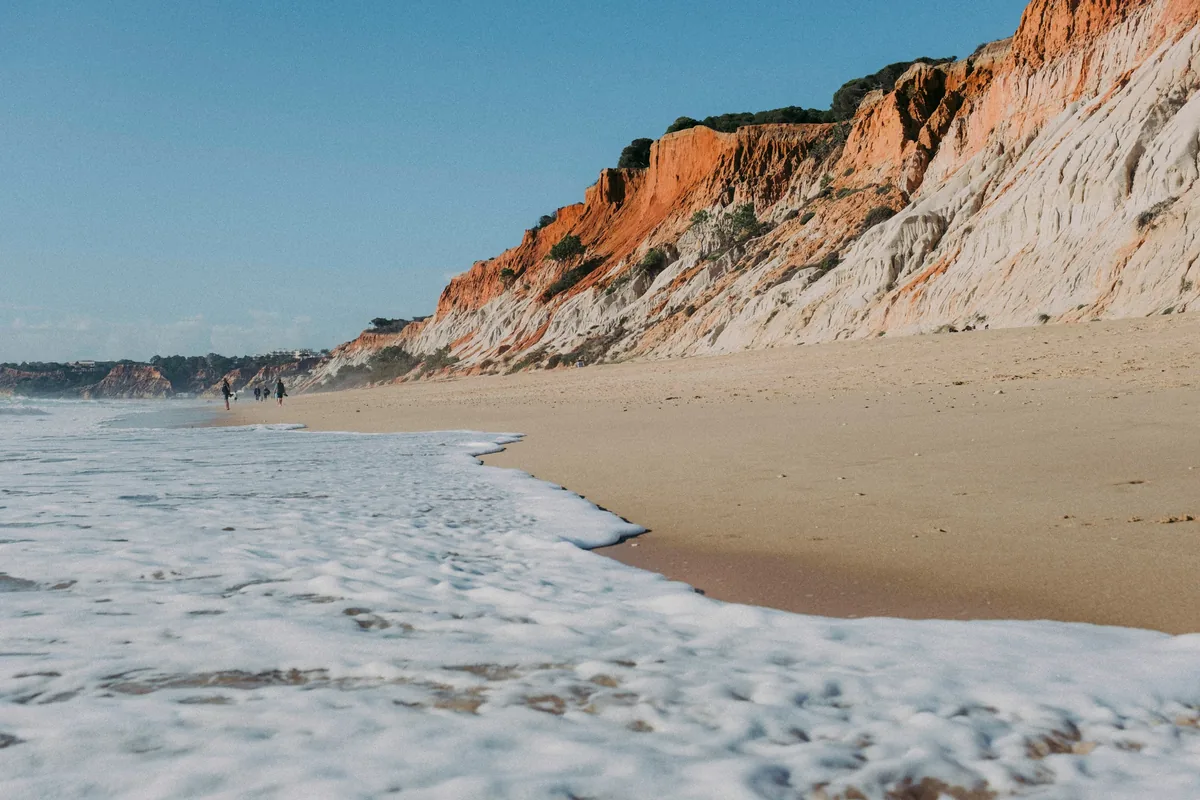
Because it’s so long, it never feels too crowded. It’s great for long walks, especially at sunset when the cliffs glow. Several resorts and beach bars sit at the eastern end.
The cliffs here are softer and more fragile than the rocks further west, so stay back from the edge and don’t climb them. A walk along the beach at low tide reveals the full range of colours in the cliff face.
- Getting there: Car parks at Olhos de Água and along the cliffs, around 15 minutes from Albufeira.
- Time needed: A beach day.
- Best time to go: Late afternoon and sunset, when the cliffs glow red and orange.
Best for: long walks and space.
4. Praia Dona Ana
Praia Dona Ana in Lagos is a small, sheltered cove framed by dramatic rock stacks. The water is calm and clear, ideal for swimming.
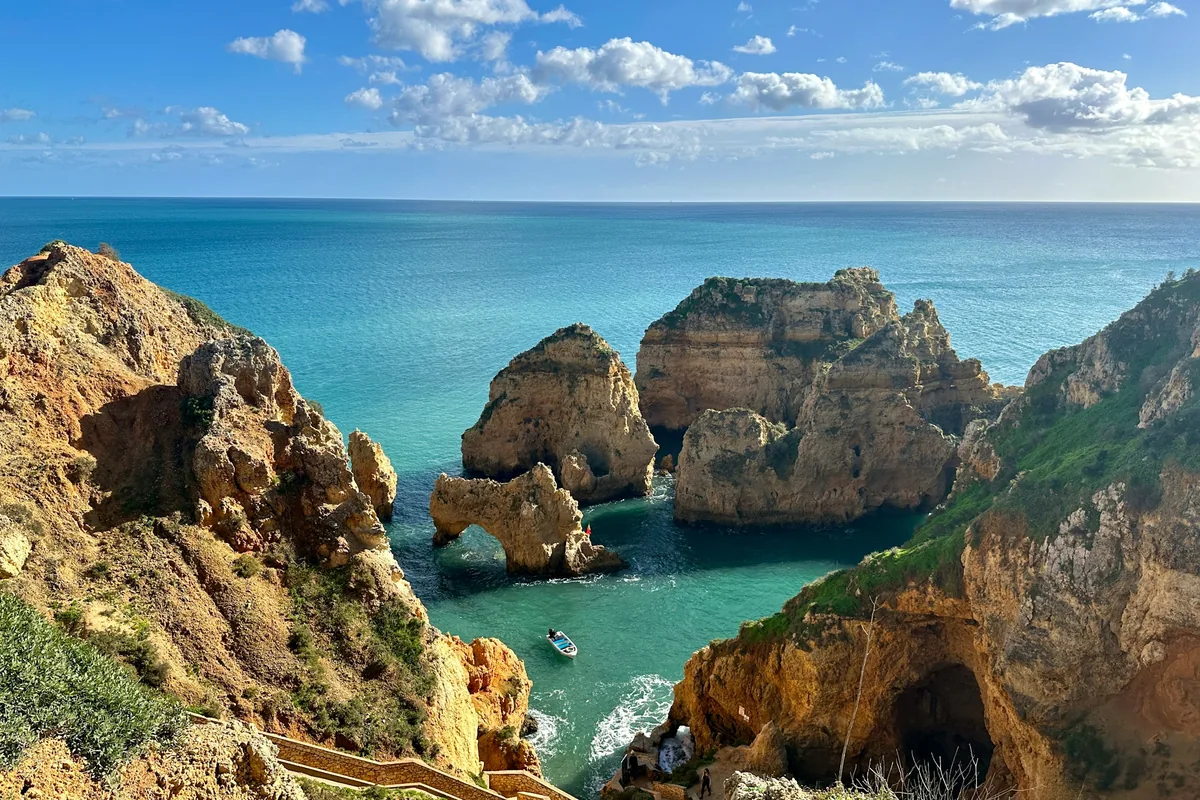
It’s a short walk from Lagos old town, so it gets busy in summer. Walk along the clifftops to Ponta da Piedade, a series of sea stacks, arches and grottoes, best seen on a short boat tour.
Boat and kayak trips to Ponta da Piedade leave from Lagos marina and slip between the rock arches and into small caves. From the lighthouse at the top, steps lead down to a jetty used by local boatmen.
- Getting there: A 15 to 20-minute walk from Lagos old town.
- Time needed: Half a day with Ponta da Piedade.
- Insider tip: Take a boat or kayak trip to Ponta da Piedade in the morning, when the water is calmest and clearest.
Best for: swimming near town.
5. Praia do Camilo
Praia do Camilo is a tiny cove near Lagos reached by a long wooden staircase of around 200 steps. The view from the top, looking down on turquoise water and golden rocks, is one of the most photographed in the Algarve.
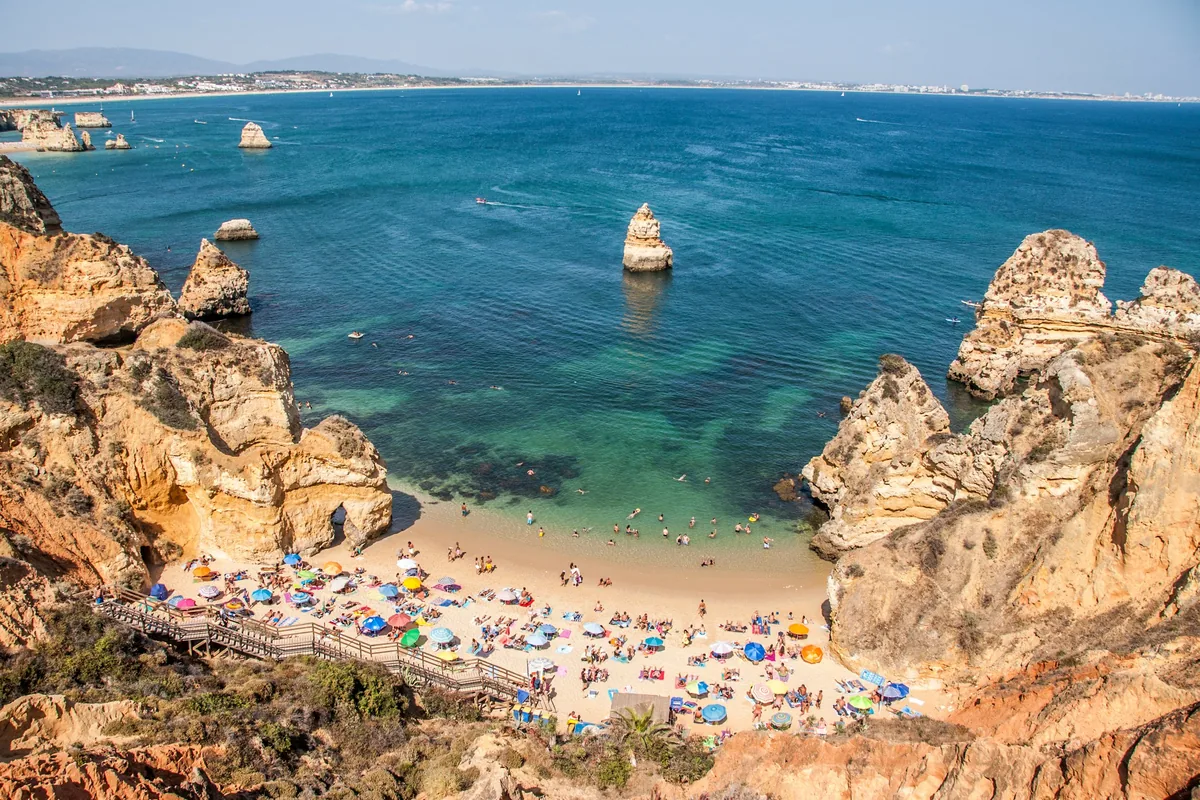
The beach is small and fills up quickly. Arrive early in the morning or late afternoon for space.
The beach sits between Lagos and Ponta da Piedade, so it’s easy to combine the two on a clifftop walk. The rocks on either side are fun to explore at low tide.
- Getting there: A short drive or a 30-minute walk from Lagos.
- Time needed: A couple of hours.
- Best time to go: Early morning or late afternoon.
Best for: photography.
6. Praia de Odeceixe
Praia de Odeceixe sits on the Algarve’s northern border, where a river meets the Atlantic in a wide sandy bay. It’s part of the protected Southwest Alentejo and Vicentine Coast Natural Park.
Families can paddle in the calm river while surfers ride the waves on the ocean side. The village of Odeceixe is small and charming, with a windmill on the hill.
The beach lies on the Rota Vicentina, a network of long-distance walking trails along the wild west coast, including the clifftop Fishermen’s Trail. At low tide, the sand stretches far out towards the sea.
- Getting there: Odeceixe is around 15 to 20 minutes north of Aljezur and about an hour from Lagos.
- Time needed: A beach day.
- Insider tip: Swim in the river if the Atlantic waves are too strong.
Best for: families and surfers.
7. Praia da Rocha
Praia da Rocha in Portimão is one of the Algarve’s biggest and most popular beaches, a wide expanse of sand backed by cliffs and hotels.
There’s a lively promenade with bars, restaurants and nightlife. It’s a good choice if you want facilities and atmosphere rather than a hidden cove. At the eastern end, the Fortaleza de Santa Catarina offers views over the river mouth.
A long wooden boardwalk runs along the beach, making it easy to walk between the bars and restaurants. The sand is wide even at high tide, so there’s room to spread out despite its popularity.
- Getting there: Praia da Rocha is a short bus or taxi ride from Portimão.
- Time needed: A beach day.
- Best time to go: Evening, when the promenade comes alive.
Best for: facilities and nightlife.
8. Praia da Ilha de Tavira
Ilha de Tavira is a long sandy barrier island reached by a short ferry from Tavira. It has 11 km of soft sand and calm, warm water.
It’s part of the Ria Formosa Natural Park, a lagoon system rich in birdlife including flamingos. The island has a campsite and some simple restaurants but feels peaceful compared with the central Algarve.
Ferries run from the centre of Tavira in summer and from Quatro Águas year-round, and water taxis are available too. The far ends of the beach are almost empty, even in August.
- Getting there: Take the ferry from Tavira or Quatro Águas.
- Time needed: A full beach day.
- Good to know: Shade is limited, so bring an umbrella or rent a sunbed.
- Insider tip: Check the time of the last ferry back before you settle in for the day.
Best for: sandy beaches and calm water.
9. Praia do Barril
Praia do Barril is known for its “anchor cemetery”, a line of rusting anchors left behind from the area’s old tuna fishing industry. It’s reached by a small train or a walk across a footbridge through the lagoon.
The old fishermen’s cottages have been turned into cafés and shops. Like Tavira Island, it has wide sand and calm water.
The little train runs across the lagoon in the main season, but the walk is short and pleasant if it isn’t running. The beach is part of the Ria Formosa Natural Park, and you may spot wading birds in the marshes along the way.
- Getting there: Drive to Pedras d’El Rei, near Santa Luzia, then cross the footbridge.
- Time needed: Half a day to a full day.
- Insider tip: Have lunch in one of the old fishermen’s cottages after a morning on the beach.
Best for: something different.
10. Praia da Bordeira
Praia da Bordeira is a huge wild beach on the west coast near Carrapateira, surrounded by dunes and cliffs. A boardwalk along the clifftop offers stunning views.
It’s a favourite with surfers and is rarely crowded, even in summer. The water is colder and rougher than on the south coast, so swim with care.
Nearby Praia do Amado is one of the best surf beaches in Portugal, with surf schools offering lessons for all levels. The coast here is part of a protected natural park, with wildflowers in spring and birds of prey above the cliffs.
- Getting there: Bordeira is near Carrapateira, around 25 minutes from Aljezur or Sagres.
- Time needed: Half a day to a full day.
- Good to know: The sea is colder and rougher than on the south coast. Only swim where it’s safe and lifeguarded.
Best for: surfing and wild nature.
When Is the Best Time to Visit the Algarve?
May, June and September are the best months for most visitors, offering warm weather, comfortable sea temperatures and fewer crowds than July and August.
- April to May: pleasant, with wildflowers on the cliffs.
- June: warm and sunny before the main crowds arrive.
- July to August: hot and busy, with the highest prices.
- September to October: the sea is at its warmest and the beaches quieter.
The Atlantic stays cooler than the Mediterranean, typically around 20 to 22°C in summer.
What Should You Know Before Visiting Algarve Beaches?
Rent a car. Many of the best beaches are hard to reach by public transport.
Arrive early in summer. Car parks at Marinha, Camilo and Benagil fill by mid-morning.
Watch the flags. Lifeguards use green, yellow and red flags. Atlantic currents can be strong, especially on the west coast.
Bring sun protection. Shade is limited on cliff-backed beaches, and the sun is strong.
Respect the cliffs. Don’t sit directly under cliffs or walk too close to the edge, as rockfalls happen. The Visit Portugal website lists official beach information.
Where Should You Stay in the Algarve?
Lagos is the best all-round base for the western Algarve, with a lively old town, great restaurants and quick access to Dona Ana, Camilo and Ponta da Piedade.
Carvoeiro is a smaller resort perfectly placed for Praia da Marinha, Benagil and the Seven Hanging Valleys Trail. Albufeira has the most hotels and nightlife, while Tavira in the east is a pretty, historic town close to the island beaches of the Ria Formosa. For surf and wild beaches, stay near Sagres or Aljezur on the west coast.
A 7-Day Algarve Beach Itinerary
A week lets you see the best of the coast from west to east, staying in two or three bases to cut down on driving.
Days 1 to 3: Lagos and the West
Base yourself in Lagos. Spend a day on Praia Dona Ana and Camilo, take a boat trip to Ponta da Piedade, and drive out to Sagres and the wild beach at Bordeira.
Days 4 and 5: Carvoeiro and the Cliffs
Move to Carvoeiro. Walk the Seven Hanging Valleys Trail, swim at Praia da Marinha and take a boat or kayak tour to the Benagil Cave.
Days 6 and 7: Tavira and the Islands
End in Tavira, with days on the Ilha de Tavira and Praia do Barril and an evening in the town’s historic centre.
Getting Around the Algarve
A hire car is the easiest way to reach the best beaches, many of which are outside towns. Pick one up at Faro Airport, the region’s main gateway.
A train line runs along the Algarve between Lagos and Vila Real de Santo António, though some stations are outside town centres. Regional buses connect the main resorts, and boat trips are the best way to see the coastline’s caves and grottoes.
How Much Does an Algarve Beach Holiday Cost?
The Algarve offers good value compared with many Mediterranean destinations, especially outside July and August. Accommodation is the biggest cost, and prices peak in the summer school holidays.
Most beaches are free to visit, with sunbeds and umbrellas for rent on organised beaches. Eat where locals do for affordable grilled fish and seafood, and look for the prato do dia at lunchtime.
Frequently Asked Questions
What is the most beautiful beach in the Algarve?
Praia da Marinha is often considered the most beautiful, followed closely by Praia do Camilo and Praia Dona Ana.
Can you swim in the Algarve in October?
Yes. The sea is usually still around 19 to 21°C in early October.
Which part of the Algarve is best for families?
The eastern Algarve, with its calm sandy islands near Tavira, and the central resorts with facilities are best for families.
Do you need a car in the Algarve?
It’s not essential if you stay in a resort, but a car makes it much easier to reach the best beaches, especially on the west coast.
Is the Benagil Cave worth visiting?
Yes. Seeing it by boat or kayak is one of the highlights of the Algarve, though you can no longer land on the beach inside the cave.
Plan Your Algarve Beach Holiday
Base yourself in Lagos for coves and cliffs, Carvoeiro for Marinha and Benagil, or Tavira for calm island beaches. Wherever you stay, the Algarve offers some of Europe’s best coastline.
Adding a city break? Lisbon is around three hours away, so add a few days with the best things to do in Lisbon, or travel further north for Porto’s riverside sights and port cellars. Want more beaches? For a quieter alternative, compare the Albanian Riviera’s best beaches.
Featured image: Photo by Rebecca Clarke on Unsplash