Last updated: October 2026
If you are wondering what to eat in Paris, start with the classics: a croissant from a proper bakery, a crusty baguette, a bowl of onion soup and a plate of steak frites. Paris is not one cuisine but a meeting point for the whole of France, so the city’s best-known dishes come from Burgundy, the south-west and the dairy farms of Normandy as much as from Paris itself. What Paris does better than anywhere is serve them in bakeries, bistros, brasseries and cheese shops that have been doing the same thing, very well, for generations.
This guide covers ten foods worth planning a day around, what makes each one special and the kind of place where you will find a good version. After the list there is a glossary of menu words, advice on booking and tipping, food plans for one, two or three days, where to stay and how to budget. The city’s official tourism website is a useful starting point for planning. Restaurant details change often, so check opening days and booking rules before you go. If Paris is one stop on a longer trip, our guide to the places most worth seeing in Europe will help you plan the rest of the route.
Quick answer: What are the best foods to try in Paris? The ten to try are the croissant, the baguette, French onion soup, escargots, steak frites, boeuf bourguignon, duck confit, French cheese, macarons and the Paris-Brest. If you only have one day, eat a croissant for breakfast, steak frites or onion soup for lunch and finish with a cheese plate or a pastry.
Quick comparison: the best foods to try in Paris
| Food | Where to try it | Best for | Price tier |
|---|---|---|---|
| Croissant | Neighbourhood bakeries, Canal Saint-Martin | Breakfast | Cheap |
| Baguette | Award-winning bakeries, 14th arrondissement | A picnic | Cheap |
| French onion soup | Les Halles brasseries | A cold evening | Mid-range |
| Escargots | Rue Montorgueil | Trying something new | Mid-range |
| Steak frites | Saint-Germain-des-Prés | A classic bistro meal | Mid-range |
| Boeuf bourguignon | Grands Boulevards bouillons | Hearty comfort food | Cheap to mid-range |
| Duck confit | Bistros in the Marais and Latin Quarter | A rich main course | Mid-range |
| French cheese | Fromageries on Rue de Grenelle and Rue Mouffetard | Tasting and picnics | Cheap to mid-range |
| Macarons | Rue Royale and Saint-Germain | Gifts and treats | Mid-range |
| Paris-Brest | Pâtisseries across the city | A special dessert | Mid-range |
1. Croissant
A croissant from a good Parisian bakery is flaky outside, soft and buttery inside, and it is the simplest way to start a food-focused day in Paris. Ask for a “croissant au beurre” if the shop makes a distinction, as the all-butter version is the one to try. The pastry is laminated, which means layers of dough and butter are folded and rolled repeatedly, so a well-made croissant shatters a little when you bite it and shows a honeycomb of air pockets when you tear it open.
The croissant sits in a family of pastries the French call viennoiserie. Its close relations are the pain au chocolat, with two sticks of dark chocolate inside, and the pain aux raisins, a spiral with custard and raisins. Most Parisians grab one at the counter on the way to work rather than sitting down, and a croissant with a coffee at a café terrace is the classic slower version.
Du Pain et des Idées, on Rue Yves Toudic near the Canal Saint-Martin, is one of the city’s most celebrated bakeries. It was opened by baker Christophe Vasseur in 2002 in a shop that has housed a bakery since the late nineteenth century, and its pistachio and chocolate “escargot” pastry is as famous as its croissants. It usually opens on weekdays only and is closed at weekends, so check before you go.
You do not need to cross the city for a good croissant. Look for a neighbourhood boulangerie with a morning queue and trays being refilled.
- How to get there: For Du Pain et des Idées, take metro line 5 to Jacques Bonsergent and walk a few minutes towards the canal.
- How long to spend: Ten to twenty minutes, or longer if you sit down with a coffee.
- Best time to go: Early morning, when the first batches come out of the oven.
- Tip: Buy a croissant and a pain au chocolat from the same bakery and compare them side by side.
2. Baguette
The baguette is the everyday bread of Paris, and a good one has a crackling crust, a creamy, irregular crumb and a slightly nutty flavour. Parisians buy them fresh, often twice a day, and you will see people walking home with a baguette under their arm, the end already torn off. The baguette’s artisanal know-how and culture were added to UNESCO’s list of the intangible cultural heritage of humanity in 2022.
Ask for a “baguette tradition” rather than a plain baguette. The tradition is made to a stricter recipe, without additives, and usually has a darker crust and more flavour. It is the version that bakers enter into the city’s annual competition, the Grand Prix de la Baguette de Tradition Française de la Ville de Paris, whose winner traditionally supplies bread to the Élysée Palace for a year.
The 2026 winner, announced by the City of Paris, was Sithamparappillai Jegatheepan of Fournil Didot, on Rue Didot in the 14th arrondissement. Past winners and finalists are spread across the city, so a winning bakery is never far away. A new winner is chosen each year, so check the City of Paris website for the latest name.
A baguette is the backbone of a Paris picnic. Buy one with some cheese, a few slices of ham and a bottle of wine, and head for the banks of the Seine, the Canal Saint-Martin or a park such as the Jardin du Luxembourg. A “jambon-beurre”, a baguette with ham and butter, is the city’s favourite sandwich.
- How to get there: For Fournil Didot, take metro line 13 to Plaisance or Pernety and walk a few minutes to Rue Didot.
- How long to spend: Ten minutes to buy, longer if you build a picnic.
- Best time to go: Late morning or late afternoon, when many bakeries bake fresh batches.
- Tip: Ask for it “pas trop cuite” if you like a softer crust, or “bien cuite” for a darker, crunchier one.
3. French onion soup
Soupe à l’oignon gratinée is the dish most closely tied to Paris itself: deeply caramelised onions in a rich broth, topped with toasted bread and a thick layer of melted, browned cheese. It is served bubbling in a heavy bowl, and breaking through the cheese crust is half the pleasure.
The soup’s Paris reputation comes from Les Halles, the city’s central wholesale food market for centuries. Market porters, traders and late-night revellers ate onion soup in the surrounding bistros in the small hours, and it became known as a warming, restoring dish after a long night. The market moved out of the centre to Rungis in 1969, but the soup stayed.
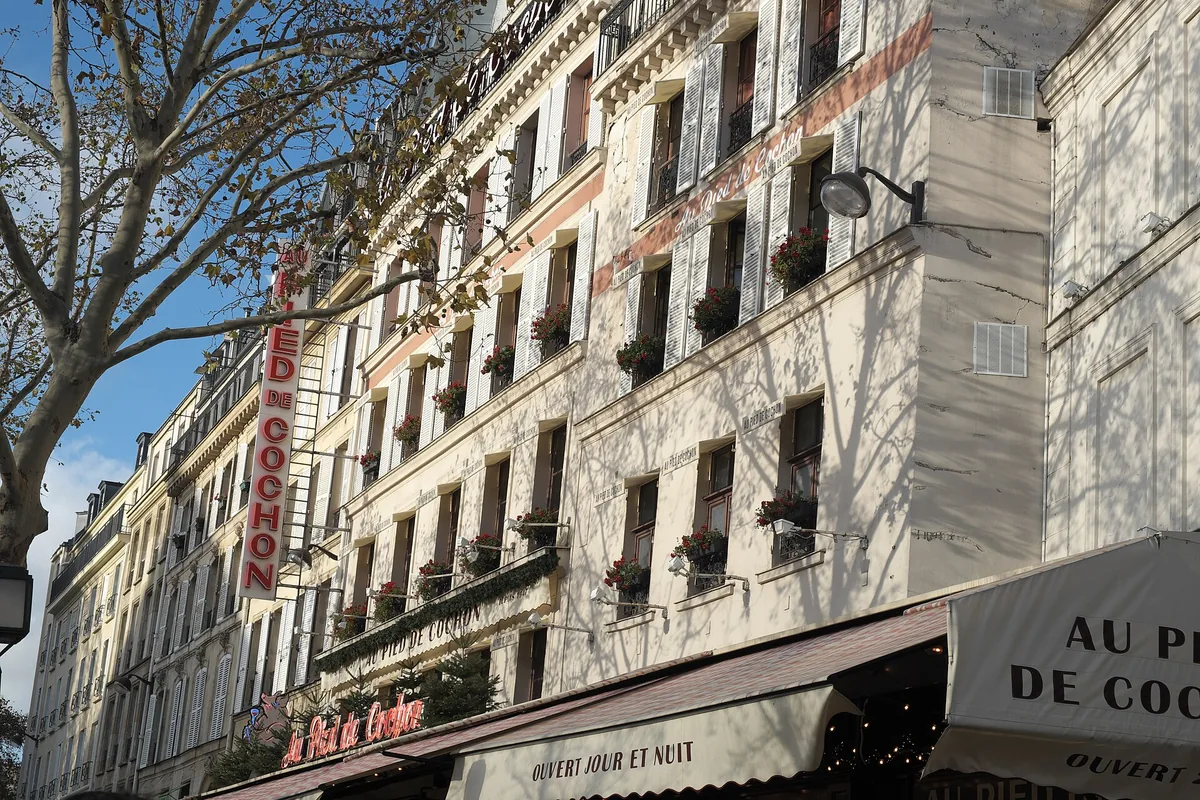
Au Pied de Cochon, on Rue Coquillière beside Les Halles, has been serving it since 1947, when it opened to feed the market workers around the clock. Its onion soup is the dish most diners order, and the menu still includes the pig’s trotters that gave the brasserie its name. Hours have varied over the years and different listings disagree, so check before you go, especially late at night. Many other brasseries across the city also serve a good version in the colder months.
A good onion soup takes time. The onions are cooked slowly until they are dark and sweet, then simmered in stock, often with a splash of wine. The cheese is usually a hard Alpine style such as Comté or Gruyère. It is filling enough to be a light meal on its own.
- How to get there: Metro or RER to Les Halles or Châtelet, then a short walk to Rue Coquillière.
- How long to spend: Forty-five minutes to an hour.
- Best time to go: A cold autumn or winter evening, or late at night after a show.
- Tip: Let the bowl cool for a minute or two. The cheese and broth stay very hot.
4. Escargots
Escargots de Bourgogne are snails baked in their shells with garlic, parsley and plenty of butter, and they are the French dish many visitors are most curious to try. The texture is a little like a mushroom or a mussel, and the flavour is mostly the herby garlic butter, so they are far less challenging than their reputation suggests.
They are usually served by the half dozen or dozen on a special dimpled plate. You hold the shell with small tongs, a “pince”, and pull the snail out with a narrow two-pronged fork. The butter left in the shells and the plate is meant for mopping up with bread, which is half the point of ordering them.
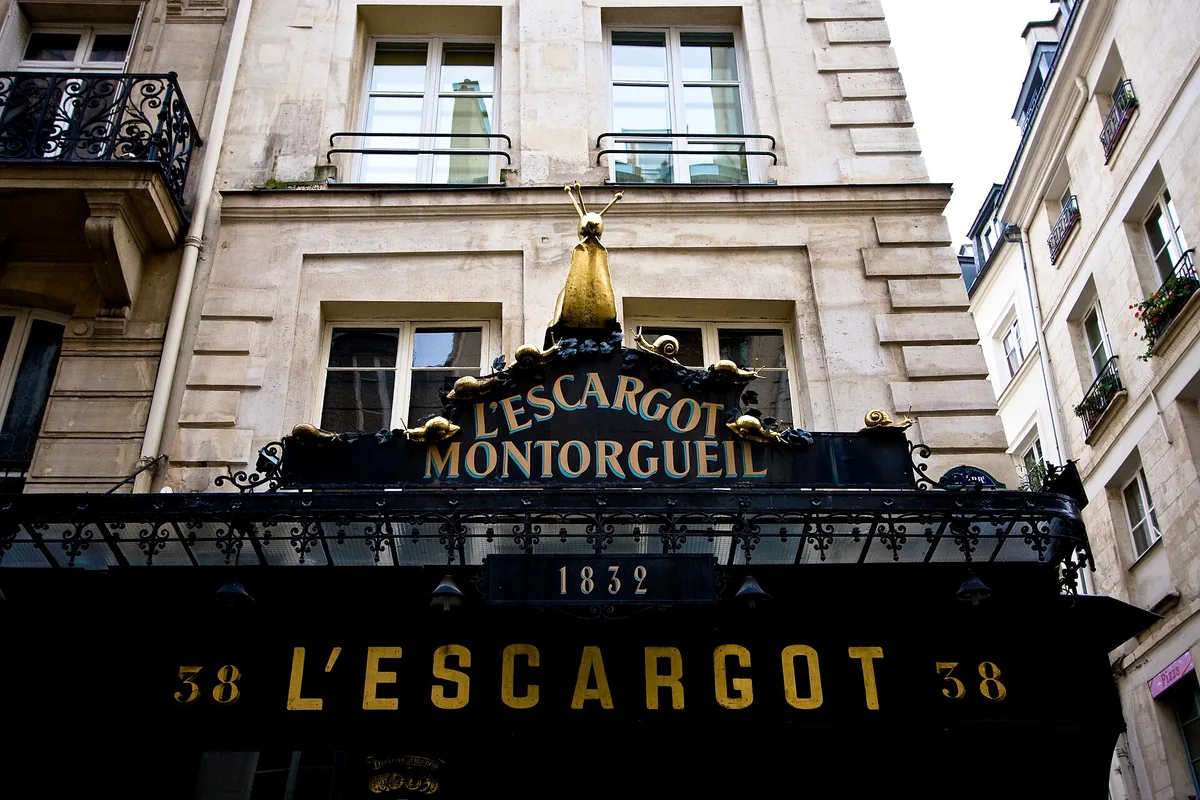
L’Escargot Montorgueil, on Rue Montorgueil near Les Halles, dates its origins to 1832 and is famous for the gilded snail above its door. It specialises in snails, serving the classic Burgundy style alongside other preparations, and its old-fashioned dining room is part of the appeal. Many traditional brasseries and bistros across Paris also list escargots as a starter, so you do not need to make a special trip.
Rue Montorgueil itself is one of the city’s best food streets, with bakeries, cheese shops, fishmongers and cafés, so it is worth walking the length of it before or after your meal.
- How to get there: Metro line 4 to Étienne Marcel or line 3 to Sentier, then a short walk to Rue Montorgueil.
- How long to spend: One hour for a meal, or longer if you explore the street.
- Best time to go: Lunch, when the street is lively and the market shops are open.
- Tip: Share a half dozen as a starter if you are not sure you will like them.
5. Steak frites
Steak frites, a pan-fried steak with a pile of thin chips, is the backbone of the Paris bistro menu and one of the most satisfying meals in the city. The usual cuts are entrecôte (rib-eye), bavette (flank) or onglet (hanger), and the steak often comes with a sauce such as béarnaise, peppercorn or a herb butter.
French kitchens cook steak rarer than many visitors expect. “Bleu” is barely seared, “saignant” is rare, “à point” is medium-rare to medium and “bien cuit” is well done. If you want it pink rather than red, ask for “à point”.
Le Relais de l’Entrecôte is the best-known place to try it. It serves a single set meal: a green salad with walnuts, followed by sliced entrecôte in its closely guarded house sauce and thin chips, with a second helping brought to the table. The only real choices are how you want the steak cooked, what you drink and whether you have dessert. It has several Paris branches, including one on Rue Saint-Benoît in Saint-Germain-des-Prés, and it does not take reservations, so queues are common at peak times.
Steak frites is also on the menu at almost every traditional bistro and brasserie, often as part of a good-value lunch set. If the chips are cut by hand and the steak arrives with a proper crust, you are in a good kitchen.
- How to get there: For the Saint-Germain branch, take metro line 4 to Saint-Germain-des-Prés and walk a couple of minutes to Rue Saint-Benoît.
- How long to spend: One hour.
- Best time to go: Arrive just before service starts to avoid the longest queue.
- Tip: Save room for the second helping of steak and chips, which is part of the meal.
6. Boeuf bourguignon
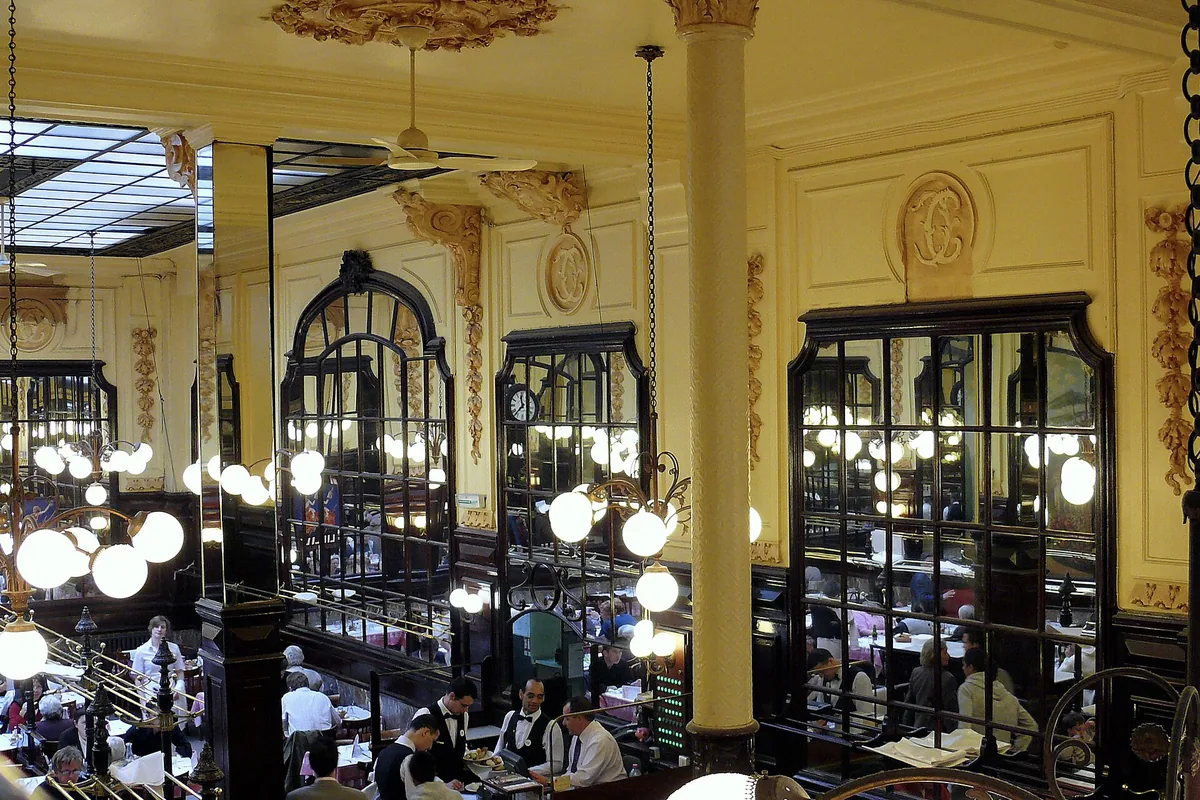
Boeuf bourguignon is a slow-cooked beef stew from Burgundy, braised in red wine with onions, mushrooms and lardons until the meat falls apart. It is one of the great comfort dishes of French home cooking, and in Paris it appears on the menus of bistros, brasseries and the city’s historic “bouillons”.
The beef is usually a tougher cut, such as chuck, that becomes tender after hours in the pot. The sauce should be dark and glossy, rich with wine but not sharp. It is typically served with boiled potatoes, mash or fresh pasta to soak up the sauce, and it is even better on the second day, which is why many kitchens make it in advance.
The best-value place to try it is a bouillon. These were large, inexpensive canteens that served simple French food to working Parisians from the late nineteenth century. Bouillon Chartier, on Rue du Faubourg Montmartre, opened in 1896 and still runs in its original dining room, with brass racks, mirrors and waiters in black waistcoats who write the bill on the paper tablecloth. Boeuf bourguignon is among its signature dishes, alongside blanquette de veau and other classics, though its menu changes with the seasons. Chartier takes no reservations and service runs continuously through the day, so the queue moves fast but can be long at peak times.
Other bouillons have opened in recent years, and they follow the same model of classic dishes at low prices in large, busy dining rooms.
- How to get there: For Bouillon Chartier, take metro line 8 or 9 to Grands Boulevards and walk a minute or two to Rue du Faubourg Montmartre.
- How long to spend: One hour.
- Best time to go: Mid-afternoon or an early dinner, when the queue is usually shorter.
- Tip: Expect to share a table with strangers at the busiest bouillons. It is part of the atmosphere.
7. Duck confit
Confit de canard is a duck leg cooked slowly in its own fat until it is meltingly tender, then roasted or pan-fried until the skin turns crisp. It comes from south-west France, where confit was a way of preserving meat for the winter, and it has long been a fixture of Paris bistro menus.
The classic plate is a single leg served with “pommes de terre sarladaises”, potatoes fried in duck fat with garlic and parsley. Some bistros serve it with lentils, salad or a fruit sauce instead. When it is done well, the meat pulls away from the bone with a fork and the skin crackles.
You will also see “magret de canard”, which is duck breast cooked pink and sliced, and cassoulet, a bean stew from the south-west that usually includes duck confit and sausage. If you like duck, both are worth ordering on a second visit.
Duck confit appears on the menus of many traditional bistros in the Marais, the Latin Quarter and Saint-Germain, as well as at some of the bouillons, though menus change with the seasons. It is a sound choice when you are not sure what to order in a classic bistro, because it is hard for a kitchen to get badly wrong and it is filling enough to skip a starter.
- How to get there: The Marais is served by metro line 1 (Saint-Paul) and the Latin Quarter by line 10 (Maubert-Mutualité) and RER B (Saint-Michel).
- How long to spend: One to one and a half hours.
- Best time to go: Lunch on a weekday, when many bistros offer a set menu.
- Tip: Order a green salad on the side to cut through the richness.
8. French cheese
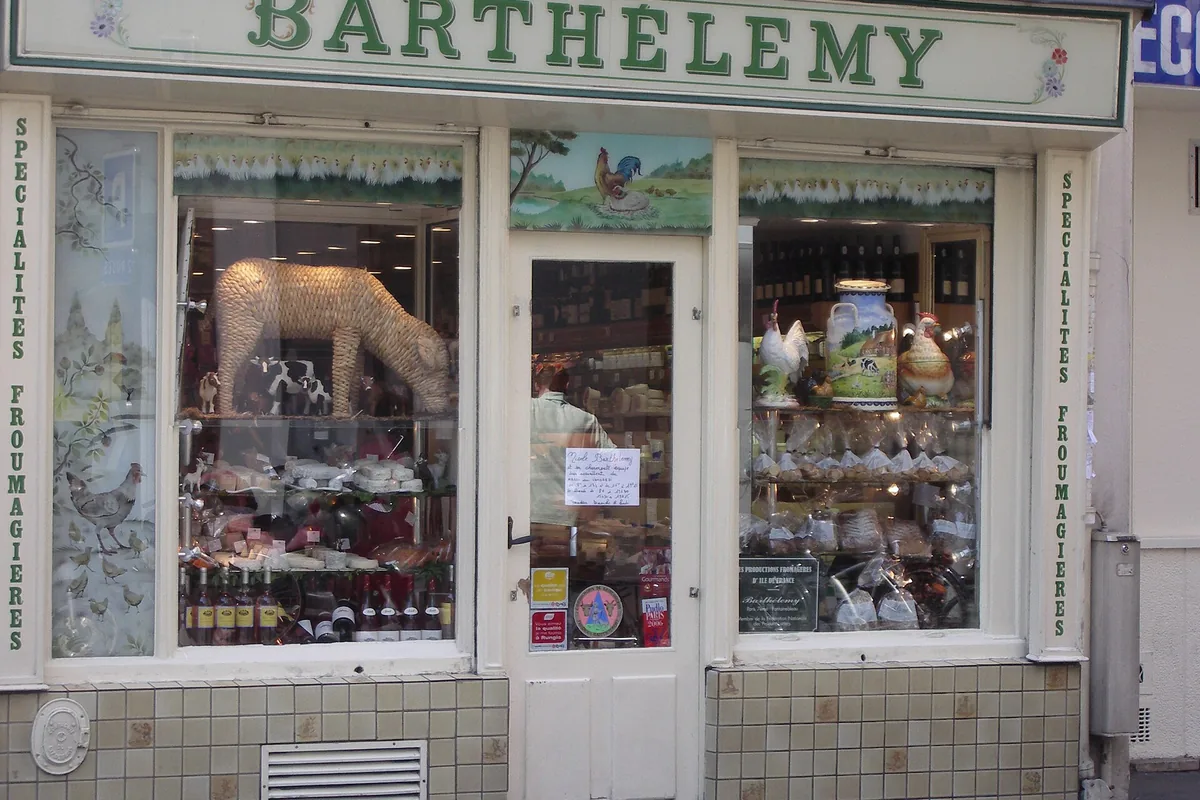
France makes hundreds of cheeses, and Paris is the best place to try them, because the city’s fromageries bring together cheeses from every region at their peak. A Paris cheese shop is a place to taste, ask questions and buy just a small piece of several kinds.
Two of the most famous soft cheeses take their names from towns east and south-east of Paris: Brie de Meaux and Brie de Melun, both protected designations. Others to look for include Comté, a nutty hard cheese from the Jura mountains; Camembert de Normandie; Roquefort, a blue sheep’s cheese; and fresh or aged goat’s cheeses from the Loire valley. A good cheesemonger will ask what you like and cut a selection that ranges from mild to strong.
Two well-known shops are Barthélémy, on Rue de Grenelle in the 7th arrondissement, and Androuet, on Rue Mouffetard in the 5th, a busy market street that is good for a food walk in its own right. Many street markets also have excellent cheese stalls, and the Marché d’Aligre near Bastille is a lively, local option. Opening days vary and many shops close on Mondays, so check before you go.
In a restaurant, cheese is served after the main course and before dessert, often as a small plate of two or three kinds with bread. Ordering the cheese course is a very French way to end a meal.
- How to get there: For Barthélémy, take metro line 12 to Rue du Bac. For Androuet on Rue Mouffetard, take line 7 to Censier-Daubenton.
- How long to spend: Twenty to thirty minutes in a shop, longer if you build a picnic.
- Best time to go: Morning, when the shops are fully stocked and the markets are busiest.
- Tip: Ask for your cheese to be wrapped for travel if you plan to take any home, and check your home country’s customs rules first.
9. Macarons
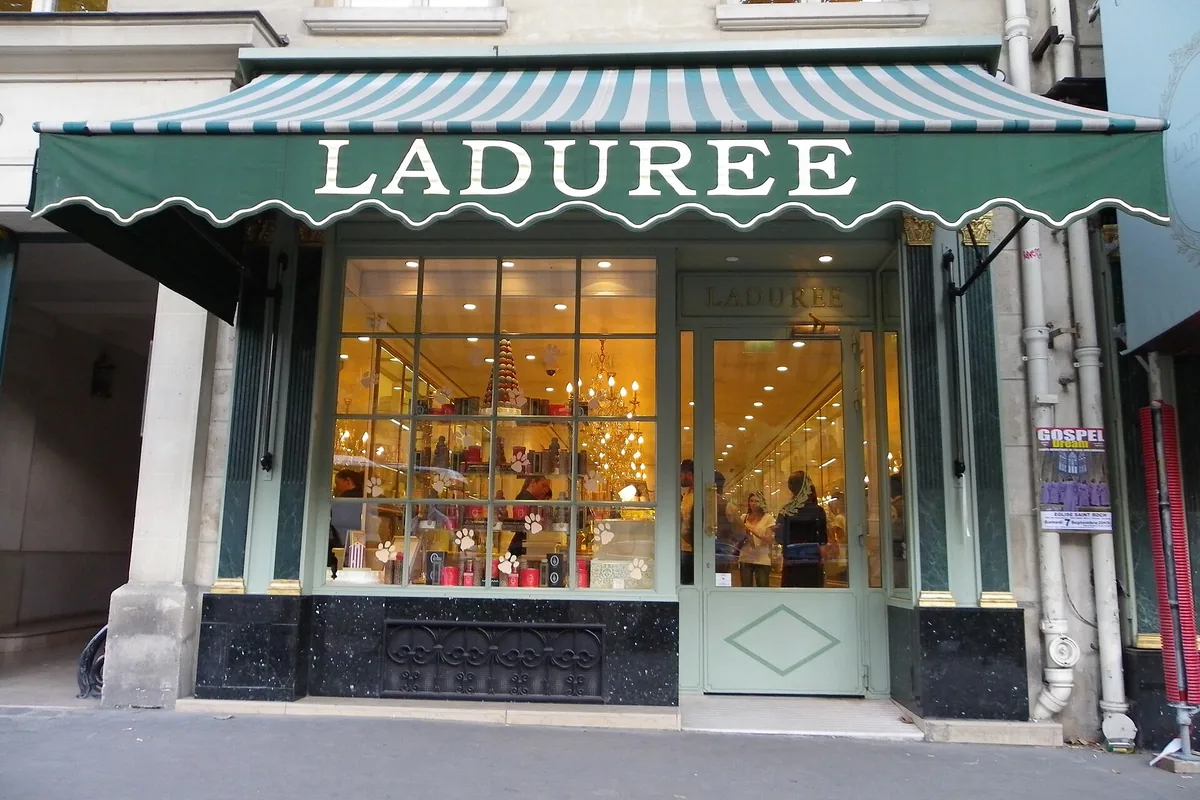
A French macaron is two crisp, delicate almond meringue shells sandwiching a filling of ganache, buttercream or jam, and Paris is where the modern version was popularised. A good macaron has a smooth top, a slightly chewy inside and a frilly “foot” around the base of each shell.
The double-decker macaron is closely associated with Ladurée, which opened as a bakery on Rue Royale in 1862. Pierre Desfontaines of the Ladurée family is usually credited with the idea of joining two shells with a filling in the first half of the twentieth century, although other pastry makers have claimed it too. The Rue Royale shop, near the Madeleine, keeps its historic tea-room look and is the one to visit if you want the setting as well as the sweets.
Pierre Hermé, who worked at Ladurée before founding his own house, is the other big name. He is known for adventurous flavour combinations alongside the classics, and his shops are spread across the city, including in Saint-Germain-des-Prés. Many independent pâtisseries also make excellent macarons, often in seasonal flavours.
Classic flavours to start with are pistachio, raspberry, chocolate, vanilla and salted caramel. Macarons travel reasonably well in their boxes, which makes them a popular gift to take home, but they are best eaten within a few days.
- How to get there: For Ladurée on Rue Royale, take metro line 8, 12 or 14 to Madeleine or line 1, 8 or 12 to Concorde.
- How long to spend: Fifteen minutes to buy, or an hour if you sit down in a tea room.
- Best time to go: Weekday mornings, before the afternoon queues.
- Tip: Buy a small mixed box from two different houses and compare them.
10. Paris-Brest
The Paris-Brest is a ring of choux pastry filled with a rich praline cream and scattered with flaked almonds, and it is one of the most satisfying classic French pastries to try in Paris. The ring shape is a nod to a bicycle wheel. The pastry is linked to the Paris-Brest-Paris cycle race, first held in 1891, and it is usually credited to Louis Durand, a pastry chef in Maisons-Laffitte, around 1910, although the story is not firmly documented.
A good Paris-Brest has crisp, golden choux pastry and a hazelnut and almond praline cream that is nutty and not too sweet. Some modern versions hide a pocket of runny praline at the centre. It is rich, so many pâtisseries also sell smaller individual rings.
Philippe Conticini is widely credited with reviving the Paris-Brest in recent decades, and his shops are a popular place to try a modern take. Pâtisserie Durand in Maisons-Laffitte, linked to the original creator, is a short train ride from central Paris for a dedicated pastry pilgrimage; check before you go. The Paris-Brest also appears in the windows of many neighbourhood pâtisseries, especially from autumn into spring.
While you are in a pâtisserie, it is worth looking at the other classics on the counter: the éclair, the mille-feuille, the tarte au citron and the baba au rhum. Stohrer, on Rue Montorgueil, opened in 1730 and is regarded as the oldest pâtisserie in Paris. It credits its founder with inventing the baba.
- How to get there: Pâtisseries are all over the city. For Maisons-Laffitte, take the RER A from central Paris, for example from Châtelet-Les Halles or Charles de Gaulle-Étoile. Some Transilien line L trains from Saint-Lazare also stop there, but not at all times, so check the current timetable before you travel.
- How long to spend: Fifteen to thirty minutes.
- Best time to go: Afternoon, for a French “goûter”, the late-afternoon snack.
- Tip: Keep it cool and eat it the same day, as the praline cream does not keep well.
How to choose what to eat in Paris
If you have limited time, plan around meals rather than sights. Breakfast is the easy win: a croissant and a coffee show you what Paris bakers can do. Lunch is the best-value sit-down meal, because many bistros offer a set “formule”. When choosing a bistro, a short handwritten menu or a chalkboard of the day’s dishes usually means the kitchen cooks to order.
Balance the rich dishes. Onion soup, boeuf bourguignon, duck confit and cheese are all heavy, so spread them across several days and pair them with lighter meals such as a salad, a market lunch or a picnic.
Follow the seasons. Onion soup and stews suit autumn and winter, while spring and summer are the time for picnics with a baguette and cheese by the river. In December, you can add mulled wine and Alsatian treats by taking the train to Strasbourg, which tops our guide to the best Christmas markets in Europe.
French food terms to know
- Boulangerie: A bakery. Look for “artisan boulanger”, which indicates bread baked on the premises.
- Pâtisserie: A pastry shop for cakes and desserts.
- Viennoiserie: Breakfast pastries such as croissants and pains au chocolat.
- Fromagerie: A cheese shop.
- Formule: A set menu, usually starter and main or main and dessert.
- Plat du jour: The dish of the day, often the freshest and best-value choice.
- Entrée: In France, this means the starter, not the main course.
- Saignant, à point, bien cuit: Rare, medium and well done.
- Carafe d’eau: A jug of tap water, which restaurants provide free on request.
- Crème brûlée: A baked custard with a burnt sugar top, a bistro favourite dessert.
Booking, tipping and opening hours in Paris
Book ahead for popular bistros, especially for dinner and at weekends. Many restaurants take bookings online or by phone. Some well-known places, including Le Relais de l’Entrecôte and Bouillon Chartier, do not take reservations, so arrive early or expect to queue.
Service is included in French restaurant bills, shown as “service compris”. Tipping is not expected, but leaving a few coins or rounding up for good service is common and appreciated.
Restaurants usually serve lunch from around midday to early afternoon and dinner from around seven or half past seven. Many traditional places close between services, and some close on Sundays, Mondays or for part of August. Bakeries open early, and many take one day off a week. Check each venue’s current hours before you go.
Suggested food plans for 1, 2 or 3 days
One day: Start with a croissant near the Canal Saint-Martin. Walk to Rue Montorgueil for escargots at lunch and a look at Stohrer’s window. In the afternoon, buy macarons near the Madeleine, and finish with onion soup at Au Pied de Cochon by Les Halles.
Two days: On day two, cross to the Left Bank. Visit a fromagerie on Rue de Grenelle or Rue Mouffetard, buy a baguette and have a picnic in the Jardin du Luxembourg. Queue for steak frites in Saint-Germain in the evening.
Three days: Spend day three on the classics. Eat boeuf bourguignon at a bouillon on the Grands Boulevards for lunch, look for a Paris-Brest for an afternoon goûter, and book a bistro in the Marais for duck confit and a cheese course at dinner.
Where to stay for food lovers
The Marais is central, walkable and full of bistros, bakeries and food shops. Saint-Germain-des-Prés suits travellers who want classic cafés, pâtisseries and the Left Bank atmosphere, though it is one of the more expensive areas. The Latin Quarter is lively and good value, with Rue Mouffetard on the doorstep. Montorgueil and Les Halles put you on one of the best food streets in the city, with excellent transport links. Canal Saint-Martin has a younger, local feel and some of the city’s best bakeries.
Getting around
Paris is a compact city, and walking between food stops is often the best way to discover bakeries and shops you would otherwise miss. The metro covers almost every neighbourhood, and the RER suburban trains are useful for longer trips, such as to Maisons-Laffitte. Buses fill the gaps and offer a view of the streets. Ticket types and passes have changed in recent years, so check the current options in the Paris tourist office’s guide to getting around Paris before you travel. Vélib’ bikes are available across the city for short hops. If you want to see more of the region between meals, our guide to the best day trips from Paris covers easy train rides to places such as Versailles and Giverny.
Budget guidance
Cheap eats: Croissants, baguettes, a jambon-beurre, cheese from a market and a meal at a bouillon let you eat very well on a small budget.
Mid-range: A bistro lunch formule, steak frites, onion soup at a brasserie and a box of macarons fall into the mid-range tier.
Special occasion: A long dinner with a starter, main, cheese course, dessert and a bottle of wine in a well-regarded bistro or brasserie. Prices rise around the major sights, so check the menu posted outside before you sit down.
Frequently Asked Questions
What food is Paris most famous for?
Paris is best known for its bread and pastries, especially the croissant and the baguette. French onion soup is the dish most closely tied to the city’s own history, through the old Les Halles market.
What should I eat for breakfast in Paris?
Most Parisians have a coffee with a croissant, a pain au chocolat or a piece of baguette with butter and jam. A neighbourhood bakery is the best place to buy it.
Do you need to tip in restaurants in Paris?
No, service is included in the bill in France. Leaving a few coins or rounding up for good service is appreciated but not expected.
Do I need to book restaurants in Paris?
It is wise to book popular bistros for dinner, especially at weekends. Some famous places, such as Bouillon Chartier and Le Relais de l’Entrecôte, do not take reservations, so arrive early.
Is eating out in Paris expensive?
It can be, but it does not have to be. Bakeries, markets, bouillons and bistro lunch set menus are all good value, and prices are usually higher right beside the major sights.
What is a traditional Parisian dish?
Soupe à l’oignon gratinée, French onion soup, is the most traditional Parisian dish. Bistro classics such as steak frites and the Paris-Brest pastry are also closely associated with the city.
Eat Your Way Around Paris
Start with a croissant, end with a cheese course and leave room for a Paris-Brest in between. If you are planning more food trips, see our guide to the best foods to try in Rome and our pick of the best places to eat in Barcelona.
Featured image: Photo by besopha, CC BY 2.0, cropped, via Wikimedia Commons