Last updated: October 2026
Europe has some of the best beach destinations in the world, and the ten below cover almost every kind: a pink-tinged lagoon in Crete, a pine-backed cove in Menorca, a city bay in the Basque Country and a wild Welsh sweep of sand. Each one is easy to find on a map, and each rewards a bit of planning.
Rules at popular beaches are changing fast, so a few of these now involve booking, car park limits or safety warnings. We point those out in every section, and link the official sources: the San Sebastián tourist board and the National Trust are good places to start.
Quick answer: What are the best beaches in Europe? The ten best are Elafonissi, Praia da Marinha, La Concha, Zlatni Rat, La Pelosa, Cala Macarella, Rhossili Bay, Palombaggia, Reynisfjara and Ksamil. For classic turquoise water choose La Pelosa, Cala Macarella or Palombaggia, and for a beach with a proper city behind it choose La Concha in San Sebastián.
Quick comparison: the best beaches in Europe
| Beach | Country | Best for | Getting there |
|---|---|---|---|
| 1. Elafonissi | Greece (Crete) | Shallow lagoon and pale sand | Car, seasonal bus or tour |
| 2. Praia da Marinha | Portugal (Algarve) | Cliffs and rock arches | Car, then steps down |
| 3. La Concha | Spain (Basque Country) | A city beach with great food | City bus or on foot |
| 4. Zlatni Rat | Croatia (Brač) | Pine shade and windsurfing | Ferry, then bus |
| 5. La Pelosa | Italy (Sardinia) | Very shallow, clear water | Car plus booked entry |
| 6. Cala Macarella | Spain (Menorca) | A pine-backed cove | Shuttle bus or coastal walk |
| 7. Rhossili Bay | Wales | Walks, surf and big skies | Car, then a short walk |
| 8. Palombaggia | France (Corsica) | Red rocks and umbrella pines | Car or summer bus |
| 9. Reynisfjara | Iceland | Black sand and basalt columns | Car or tour from Reykjavik |
| 10. Ksamil | Albania | Small beaches and islets | Bus or taxi from Sarande |
1. Elafonissi
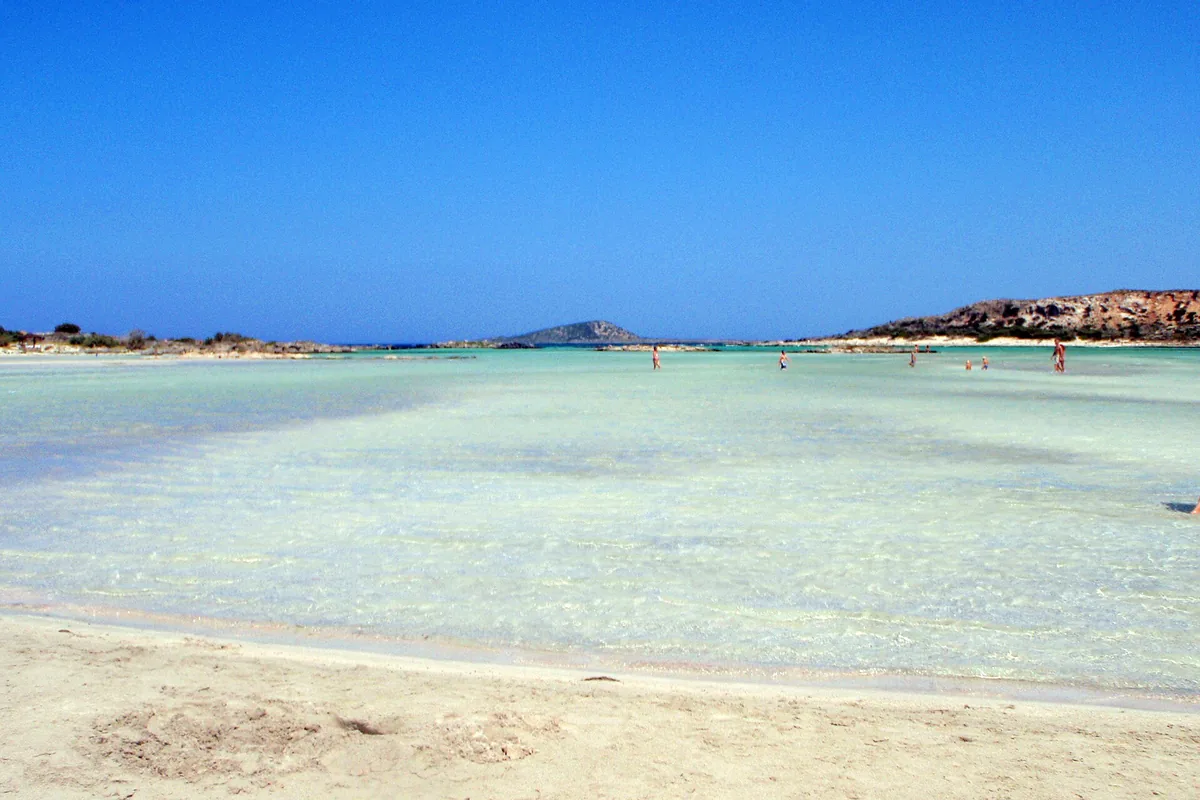
Elafonissi is the beach most people picture when they imagine Crete’s turquoise water. On the island’s south-west corner, a shallow, warm lagoon sits behind a sandbar, and the pale sand takes on a pink tinge where tiny shell fragments gather along the waterline. At the right tide you can wade across to the small islet beyond, with dunes and low juniper to explore.
The whole area is a protected Natura 2000 site, so it is not a place to treat casually. Taking sand, shells or plants away is forbidden, and the dunes are fragile, so stay on the marked paths and avoid walking over the vegetation. Loggerhead turtles use parts of Crete’s coast, which is one more reason to keep to the rules.
The beach is best known for its shallow water, which makes it good for small children. The flip side is that it is popular, and the main strip fills with sunbeds and umbrellas in high summer. Walk a few minutes along the lagoon edge or towards the islet and the crowds thin out quickly.
The road from the north coast is slow and winding, so allow plenty of time. Many visitors join an organised day tour from Chania or Rethymno, while others hire a car and make a longer day of it.
- How to get there: By car from Chania in roughly one and a half to two hours on a winding road, by seasonal KTEL coach from Chania (check the timetable), or on an organised tour.
- How long to spend: A full day, including the wade across to the islet.
- Best time to go: May, June or September for warm water and fewer people.
- Tip: Bring water shoes for the sandbar, sun cover and your own snacks, and arrive early before the coaches.
2. Praia da Marinha
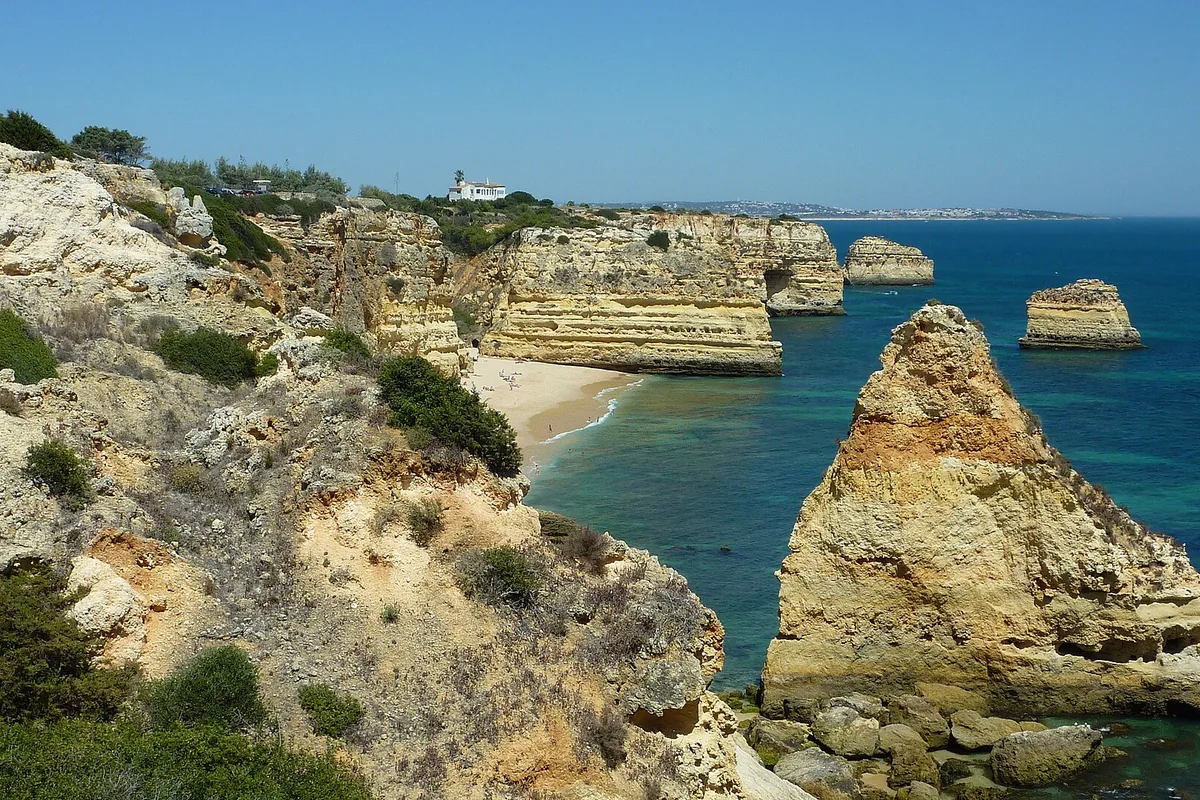
Praia da Marinha is one of the Algarve’s most photographed beaches, and the view from the cliff top is half the reason to come. Honey-coloured sandstone cliffs, sea stacks and natural arches frame a compact beach in the Lagoa area, and the water is clear enough that snorkellers see fish from the shallows. It sits on the same stretch of coast as the sites covered in our guide to the best Algarve beaches.
You reach the sand by a long wooden staircase, which makes the beach unsuitable for wheelchairs and buggies. The climb back up is the hard part, so pace yourself in the heat. A coastal walking route, often called the Seven Hanging Valleys trail, runs along the clifftop here and continues towards Benagil, and the views along it are some of the best in southern Portugal.
Stay well back from the cliff edge, especially on windy days, and obey any warning signs about unstable ground. Do not walk or swim beneath the rock arches, and check the tide before you go: at high water much of the sand disappears and swimming becomes less comfortable.
Public transport here is limited, so most visitors drive or arrive on an organised boat or kayak trip along the coast. The car park above the beach fills early in summer, and there are further parking areas along the trail.
For up-to-date information on beach flags and lifeguard cover, check with the Lagoa council or the Visit Portugal site before you set out.
- How to get there: By car from Lagoa or Carvoeiro, or by boat tour along the coast. Local buses are very limited, so check before relying on them.
- How long to spend: Two to three hours, or half a day if you walk part of the clifftop trail.
- Best time to go: Morning, or late afternoon for softer light on the cliffs.
- Tip: Walk the clifftop path at sunset, but keep to the marked route.
3. La Concha, San Sebastián
La Concha is one of Europe’s best city beaches, because it combines a perfect crescent of sand with one of Spain’s great food towns. The bay curves around a small island, Santa Clara, with the mountains of Igueldo and Urgull at either end, and a classic seafront promenade runs along its length. You can swim, walk and then be in a pintxos bar in the Old Town within minutes.
The beach is not a secret, so expect it to fill on warm weekends. Because the bay is wide, it is easy to find your own patch of sand, particularly towards the Ondarreta end. The tide changes the beach dramatically, and at low tide a wide strip opens up, while at high water the sand can shrink to a narrow band.
Santa Clara island lies a short distance offshore and is reached by boat, kayak or paddleboard in the warmer months. A small beach on the island is very tide dependent, so treat it as a bonus rather than a plan.
Away from the sand, the old town has a dense cluster of pintxos bars, and the funicular up Monte Igueldo gives a famous view of the whole bay. Check the official San Sebastián tourism site for beach services, lifeguard information and any local rules.
- How to get there: On foot from the Old Town, or by local city bus from the centre. San Sebastián is a short transfer from Bilbao or Biarritz airports.
- How long to spend: A relaxed half day, or a full day if you add pintxos and the Igueldo viewpoint.
- Best time to go: July to early September for swimming, though the atmosphere is lovely in June.
- Tip: Check the tide before you choose where to sit, and watch the swimming flags.
4. Zlatni Rat
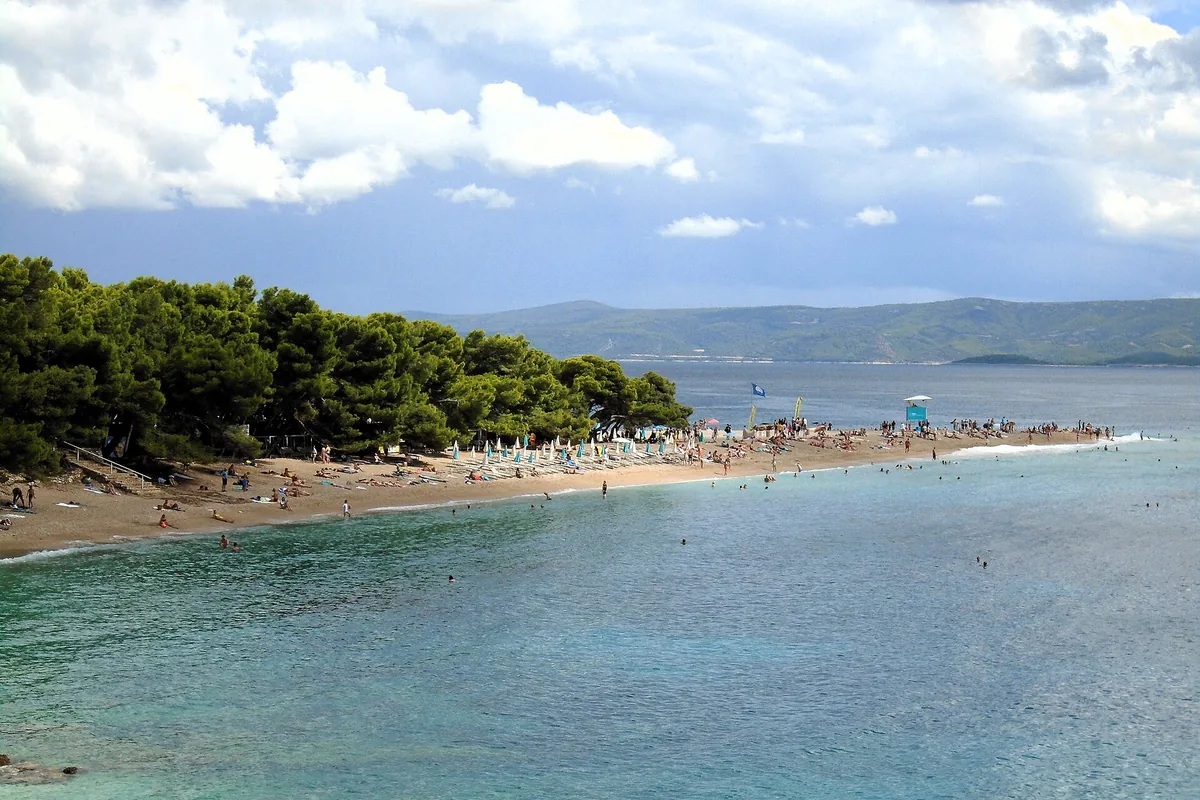
Zlatni Rat, or Golden Horn, is Croatia’s most recognisable beach and a rare shingle spit that points out into the Adriatic. It sits beside the town of Bol on the south coast of Brač, backed by pine trees that give welcome shade. The tip of the spit shifts with the wind and currents, which means its shape is slightly different from one year to the next.
Despite the name, the surface is fine pebbles and shingle rather than soft sand, so water shoes are a good idea. The reward is very clear water, and the long promenade from Bol makes the walk to the beach part of the experience. The beach is also known for windsurfing and kitesurfing, because afternoon winds often build along this part of the coast.
The beach can be crowded in July and August, and cafes and watersports operators line parts of the back of the beach. Walk towards the tip for more space, or visit early in the day. Nearby Bol has a harbour, restaurants and a handful of low-key places to stay, so it works as a base for several days. If you want to add more of the Adriatic, our guide to the best Croatian islands to visit helps you choose where to island-hop next.
Most visitors come from Split. A passenger catamaran runs to Bol in the main season, and the alternative is the car ferry to Supetar followed by a bus across the island. Schedules change, so check Jadrolinija or the local operators before you plan a day trip.
- How to get there: Ferry from Split to Supetar then a bus to Bol, or a seasonal passenger catamaran direct to Bol, then a walk along the seafront.
- How long to spend: A full day, with time for lunch in Bol.
- Best time to go: June or September for warm water, with less crowding than midsummer.
- Tip: Walk to the far end of the spit for a quieter spot, and bring water shoes for the shingle.
5. La Pelosa
La Pelosa is Sardinia’s best-known beach, and its very shallow, clear water makes it one of the most beautiful in the Mediterranean. It lies at the northwest tip of the island near Stintino, with a small stone watchtower on a rock just off the sand and the island of Asinara visible beyond. The sand is white and the water stays shallow far from the shore.
The beach has become a case study in protecting a popular place. In peak season, entry is controlled through a booking system on the official La Pelosa site, with a small fee and a daily limit on visitors. A mat under your towel is also required, to stop sand being carried away, and rangers check this. Rules and dates can change from year to year, so confirm them before you book flights.
Smoking is restricted, and you are expected to take all rubbish away and respect the dunes and the water. These measures keep the beach in better condition, and they also mean it is less crowded than it would otherwise be.
Outside the booking period, the rules are more relaxed, and shoulder-season visits can be quieter and cheaper. Stintino also has a good fishing-village feel, with harbour restaurants serving local fish.
For an alternative with fewer controls, the nearby coast has other beaches, but none has quite the same shallow clarity.
- How to get there: By car from Alghero airport, roughly an hour away, then a short walk from the car park. Check the official site for the current booking and parking rules.
- How long to spend: Half a day, which suits the booking system.
- Best time to go: Late May, June or September, when the water is warm but the beach is less busy.
- Tip: Buy your straw mat in town or a supermarket before you reach the beach, and book your slot early.
6. Cala Macarella
Cala Macarella is Menorca’s most photographed cove, with turquoise water, white sand and a wall of pine trees behind it. It sits on the island’s south-west coast, and the shallow, calm water makes it popular with families. A short path leads over the rocks to the smaller Cala Macarelleta, which has a more secluded feel.
Menorca is a UNESCO Biosphere Reserve, and its authorities manage visitor numbers carefully. In the busiest months, the car park closest to the beach is generally closed to private cars, and a summer shuttle bus runs from the nearby area, so check Descobreix Menorca and the current bus operator for rules and times. Outside the peak summer months you can often park and walk the short final stretch.
The best-known walking route is the Camí de Cavalls, the old coastal path that circles the island. The stretch from Cala Galdana to Macarella is a popular half-day walk, taking in pine woods and small coves. It is a lovely way to arrive, and it avoids the car park question altogether.
Facilities are modest, with a small seasonal bar behind the beach, so bring water and anything else you need. The cove is not large, and in high summer the sand fills from mid-morning.
- How to get there: Seasonal shuttle bus from the Ciutadella side in summer, by car in shoulder season, or on foot along the Camí de Cavalls from Cala Galdana.
- How long to spend: Half a day, longer if you walk in.
- Best time to go: May, June or late September, or any time before mid-morning in summer.
- Tip: Take the coastal path from Cala Galdana for the best views and no parking stress.
7. Rhossili Bay
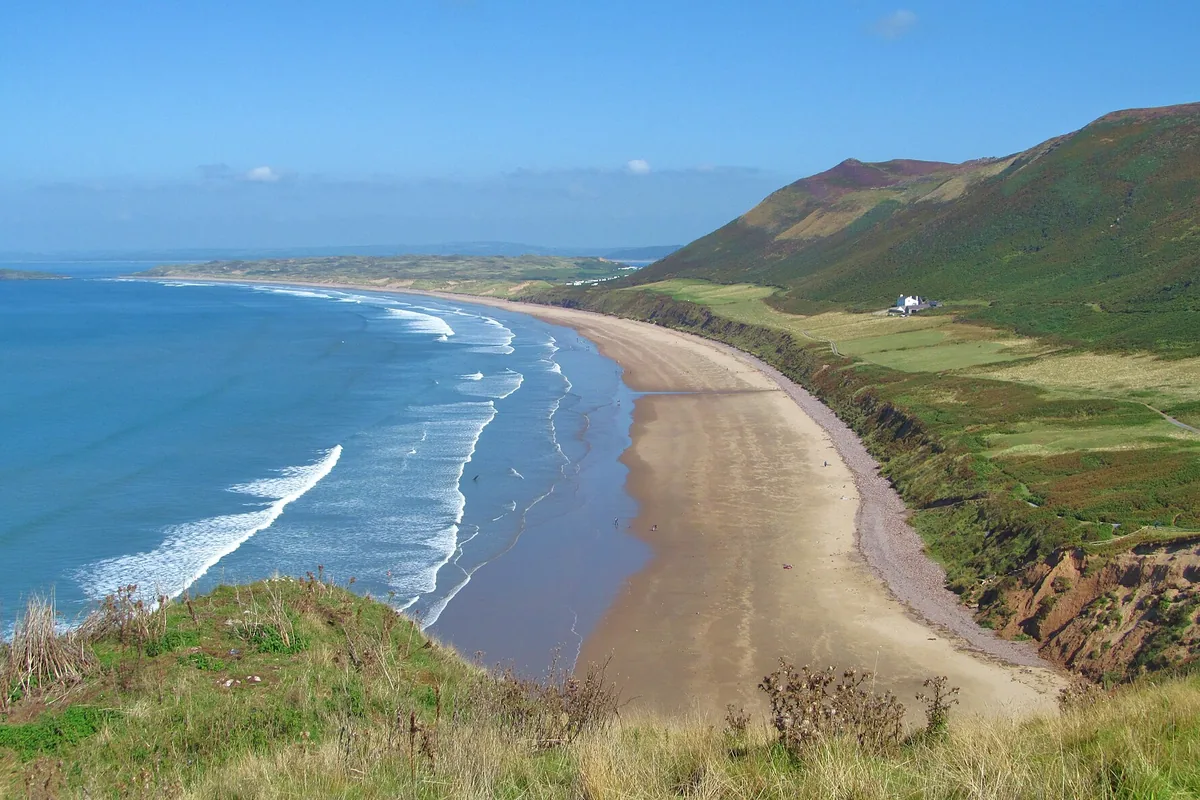
Rhossili Bay is the wildest and most dramatic beach on this list, a long curve of sand backed by green downland on the Gower Peninsula. The Gower was the first part of the UK to be named an Area of Outstanding Natural Beauty, and Rhossili shows why. At the southern end, Worm’s Head juts into the sea like a sleeping dragon, while the beach itself stretches for miles.
The sand is wide and the bay is exposed, so this is a beach for walking, kite-flying, surfing and watching storms roll in rather than for sunbathing in a crowd. At low tide the ribs of an old shipwreck, the Helvetia, can sometimes be seen on the sand. Above the beach, a clifftop path and a grassy down give views over the whole bay.
The causeway to Worm’s Head is passable only around low tide, and it is a serious undertaking. The National Trust advises that access is possible for a limited window either side of low water, and that you should never try to beat the tide back. Access to the outer head is usually restricted from around February to July to protect nesting birds. Check the National Trust Rhossili page and the local coastguard lookout for tide advice before setting out.
Water here can be cold and the currents strong, so swim only where lifeguards are on duty in season and follow the flags. If wild coastline appeals, our pick of the Scottish islands offers more empty sands in the same spirit.
- How to get there: By car to the National Trust car park at Rhossili village, then a short walk down to the sand. Public transport is limited, so check local bus options from Swansea.
- How long to spend: Half a day for the beach, or a full day with the Worm’s Head and downland walks.
- Best time to go: Spring and early autumn for clear light and fewer people, or summer for swimming.
- Tip: Check the tide table before you plan a Worm’s Head walk, and wear proper footwear.
8. Palombaggia
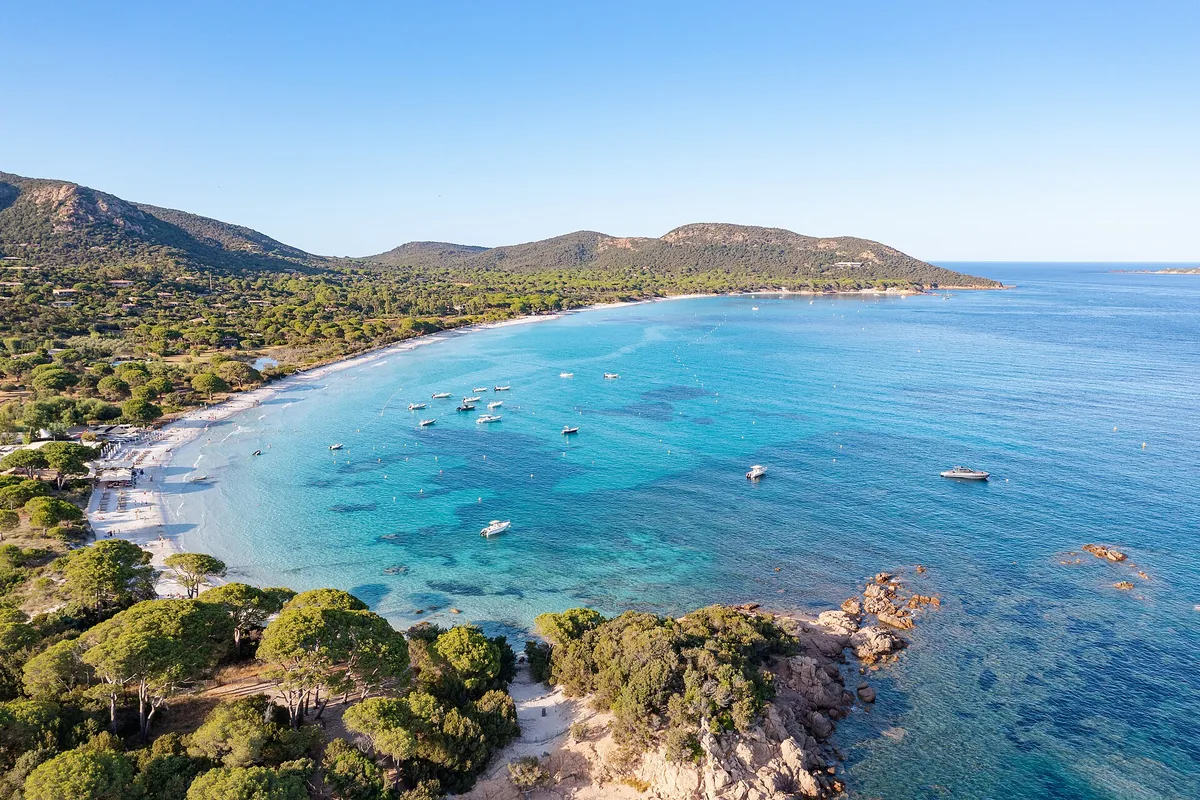
Palombaggia is the postcard beach of southern Corsica, where red rocks, umbrella pines and clear shallow water make a vivid contrast. It lies a short drive south of Porto-Vecchio, and the sand is pale and soft. Out to sea, the Cerbicale islands sit on the horizon, and the water is calm in most conditions.
Behind the beach, a belt of pines and dunes gives shade, and small restaurants and beach clubs sit along the back of the sand. Stay on the paths and look after the vegetation and dunes, and treat them as protected rather than as a playground.
Parking is the main practical issue. The free car parks fill quickly in midday summer traffic, while other lots belong to restaurants and may charge a fee. If you can, arrive early in the morning or come in the shoulder season. Some summer bus services may run from Porto-Vecchio towards the beaches, so check locally as an alternative to driving.
If Palombaggia is too busy, the coast nearby offers other options, including Santa Giulia to the south and Tamaricciu, which can be quieter. Check the Visit Corsica tourism site for local advice and beach information.
- How to get there: By car or taxi from Porto-Vecchio in about twenty minutes, or by seasonal bus in summer if one is running.
- How long to spend: Half a day to a full day.
- Best time to go: June or September for warm water and easier parking.
- Tip: Arrive early, because the best parking disappears by mid-morning in July and August.
9. Reynisfjara
Reynisfjara is one of Europe’s most dramatic beaches, a black sand shore beneath basalt columns on Iceland’s south coast, and it is for looking at rather than swimming. Near the village of Vik, the sand is made of dark volcanic grains, and the cliff behind is formed of regular hexagonal columns. Offshore, the Reynisdrangar sea stacks rise out of the Atlantic.
This beach is beautiful but dangerous. Sneaker waves can run much further up the sand than expected, and the water is extremely cold and powerful. Visitors have been swept out to sea. Stay well back from the water, never turn your back on the waves, and do not treat dry sand as safe. A coloured warning light system is in place at the entrance, and the safety advice from SafeTravel Iceland should be checked on the day.
The basalt columns and the sea cave at the base of the cliff are the main things to see, and both are easy to enjoy from a safe distance. Wind and rain can be fierce, so dress in waterproof layers whatever the season.
Reynisfjara is roughly two and a half hours by road from Reykjavik, so many visitors combine it with waterfalls along the south coast. In winter, check road and weather conditions before you drive.
- How to get there: By hire car or organised south coast tour from Reykjavik, about two and a half hours each way.
- How long to spend: One to two hours at the beach, within a full day on the south coast.
- Best time to go: Daylight hours in calm weather, in summer for the longest days or in winter for dramatic light.
- Tip: Keep well back from the waves, and check the warning light and weather before you go down.
10. Ksamil
Ksamil is a short hop from Corfu and offers clear, Caribbean-style water on Albania’s far south coast, without a long flight. On Albania’s far south coast, a cluster of small beaches faces three tiny islets, and Corfu is visible across the water. The sea is clear and often calm.
Most of the beaches here are run by bars and beach clubs that rent sunbeds and umbrellas, and in peak season the area is busy. Some of the smaller beaches and the free patches of sand fill early. If you want quieter water, go in late spring or September, and arrive before mid-morning.
The village is a good base for a longer trip because it sits close to Butrint, a UNESCO World Heritage site with Greek, Roman and Byzantine remains in a national park about a short drive south. Sarande, the nearest larger town, has a harbour, restaurants and the ferry link to Corfu.
Ksamil has grown quickly, so expect building work and traffic on the main road in summer. Parking around the beaches is limited, so arriving early or staying within walking distance helps. For a more peaceful stay, look for accommodation slightly back from the shoreline. Our guide to the Albanian Riviera beaches covers more of this coast.
- How to get there: Local bus or taxi from Sarande, or a short ferry from Corfu to Sarande followed by a transfer.
- How long to spend: A full beach day, plus a half day at Butrint.
- Best time to go: Late May, June or September, when the water is warm and prices and crowds are lower.
- Tip: Visit early in the morning, and check what a sunbed includes before you sit down.
How to pick the right beach
Start with the kind of day you want. For shallow, family-friendly water choose Elafonissi, La Pelosa or Cala Macarella. For scenery and walking choose Praia da Marinha, Rhossili Bay or Reynisfjara, remembering that the last is not for swimming. For a beach with a city attached, La Concha is hard to beat. For a lively, budget-friendly coast, Ksamil is the best fit.
Think about access too. La Pelosa needs a booking in peak season, Cala Macarella has restricted car parking in summer, and Zlatni Rat means a ferry. Booking and checking rules early removes most of the stress.
Suggested routes for a week or two
- Greek and Adriatic week: Fly to Crete for Elafonissi, then spend a few days around Split and Bol for Zlatni Rat.
- Iberian week: Combine La Concha in the north with Praia da Marinha in the south, using domestic flights, or choose Menorca for Cala Macarella on its own.
- Island hopping in the western Mediterranean: Pair La Pelosa in Sardinia with Palombaggia in Corsica, which are connected by ferries from the north of Sardinia. For another Italian coastline, see our guide to the Amalfi Coast towns.
- Atlantic week: Visit Rhossili Bay in Wales, then fly to Reykjavik for Reynisfjara, dressing for wind and rain.
Getting around
Most of these beaches are easiest with a hire car, especially Elafonissi, Praia da Marinha, La Pelosa, Palombaggia, Rhossili Bay and Reynisfjara. Where parking is limited, buses or shuttles can be easier, as at Cala Macarella and Zlatni Rat. La Concha is walkable from the centre of San Sebastián, and Ksamil is a short bus or taxi ride from Sarande. Check current timetables with the operators, since seasonal services change from year to year.
Where to stay
- Near Elafonissi: Small villages on the south-west coast of Crete, or Chania if you prefer a city base.
- Algarve: Lagoa and Carvoeiro are the closest towns to Praia da Marinha.
- San Sebastián: The Old Town and the streets near the beach are the most convenient.
- Brač: Bol is the natural base for Zlatni Rat.
- Northern Sardinia: Stintino for La Pelosa, with Alghero as an alternative.
- Menorca: Ciutadella or Cala Galdana for Cala Macarella.
- Gower: Rhossili village or Swansea for the Welsh coast.
- Corsica: Porto-Vecchio for Palombaggia.
- South Iceland: Vik for Reynisfjara.
- Albania: Ksamil or Sarande.
Budget guidance
- Shoestring: Ksamil and Rhossili Bay tend to be the more affordable bases, and La Concha is free to use. Pack your own picnic almost anywhere.
- Mid-range: Menorca, Crete, the Algarve and Croatia offer a wide range of mid-priced hotels and restaurants outside July and August.
- Comfortable: Corsica, Sardinia, San Sebastián and Iceland tend to cost the most, especially in peak season, so book early.
Frequently Asked Questions
What is the most beautiful beach in Europe?
It depends on taste, but Elafonissi, La Pelosa, Cala Macarella and Palombaggia are among the most often chosen for their clear water and scenery. For a more dramatic setting, Reynisfjara and Rhossili Bay are hard to beat.
Which European beaches are best for families?
Elafonissi, La Pelosa and Cala Macarella have very shallow, calm water, which suits small children. La Concha also works well because the city is right behind it.
What is the best month to visit beaches in Europe?
June and September are usually the best balance of warm water, lower prices and fewer crowds. July and August are the busiest, and some beaches have booking or parking limits then.
Do I need to book to visit any of these beaches?
La Pelosa uses an official booking system in peak season, and parking or shuttle rules apply at Cala Macarella. Check the official sites before you travel, because rules change.
Is it safe to swim at Reynisfjara?
No. Strong sneaker waves and very cold water make swimming unsafe. Enjoy the beach from a safe distance and follow the warning signs.
Are there beaches in Europe with sand that is not white?
Yes. Reynisfjara has black volcanic sand, Elafonissi has a pink tinge, and Zlatni Rat is made up of fine pebbles instead of sand.
Featured image: Photo by Paul Stephenson, CC BY 2.0, cropped, via Wikimedia Commons